Quick answer: casino strategies cannot produce reliable income. Gambling places money on uncertain outcomes, and a short run of wins does not create a salary, investment return, or repeatable monthly result. If you choose to gamble, treat the full amount as optional entertainment spending that may be lost.
This page corrects older “money-making strategy” advice. It does not recommend a game, profit goal, staking system, bonus, or withdrawal tactic. The practical goal is to protect essential money, limit exposure, recognize biased records, and stop before gambling creates financial harm.
When gambling is connected to debt or essential bills, start with the debt-pressure action guide instead of another betting plan.
Why Gambling Cannot Function Like Reliable Income
Income planning needs a result you can estimate and use for rent, food, bills, debt payments, savings, and emergencies. Gambling does not offer that stability. Results vary, losses can cluster, and a win can be followed by a larger loss.
| Income-plan requirement | Why gambling does not meet it |
|---|---|
| Predictable amount | The next result and session total are uncertain. |
| Predictable timing | A win is not scheduled and cannot be required to arrive before a bill. |
| Capital protection | The money placed at risk can be lost. |
| Repeatability | A result that occurred once does not prove it will repeat. |
| Evidence of performance | Selective memory can hide deposits, losses, bonuses, fees, and time spent. |
The World Health Organization defines gambling as risking money or something of value on an uncertain event. It also notes that gambling harm can include financial distress and diversion of household spending from essential goods and services.
Strategy Changes Decisions, Not Uncertainty
A staking plan can change how much you risk on the next round. It does not guarantee which card, number, symbol, or sports result comes next. Doubling after a loss increases the next stake; it does not repair the previous result or force a recovery.
Likewise, a stop-after-win rule can end a favorable session, but it does not prove that the method generated reliable income. If the same rule is tested honestly, every deposit, loss, fee, bonus condition, withdrawal, and hour spent must be included.
Protect Essential Money Before Setting an Entertainment Budget
Do not start with “How much can I win?” Start with “What money must never be exposed?”
- Protect food, housing, utilities, transport, medicine, education, and family support.
- Protect minimum debt payments and agreed repayment plans.
- Protect emergency savings.
- Do not use borrowed money, credit, cash advances, or money held for another person.
- Only after those needs are covered, decide whether any optional entertainment amount remains.
The entertainment amount is a spending cap, not working capital. Assume it can be lost completely. If losing it would create stress or require replacing it from essential funds, the affordable gambling budget is zero.
Use Loss and Time Limits as Stop Boundaries
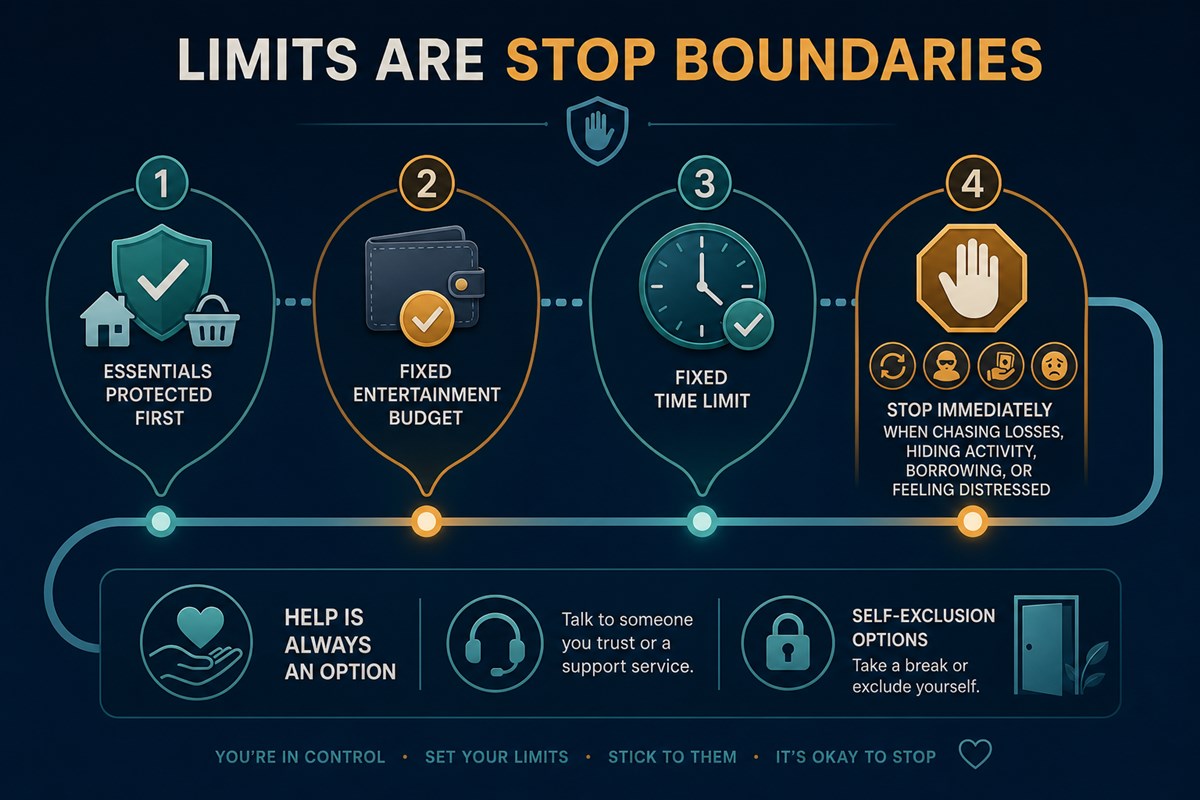
A limit does not improve the odds. It limits exposure. Write the amount and end time before opening a game, and do not increase either after a win or loss.
- Loss boundary: stop when the optional amount is spent.
- Time boundary: stop at the planned time, even if the session feels unfinished.
- No-reload boundary: do not add more money during the same session.
- No-recovery boundary: do not increase a wager to recover a loss.
- State boundary: do not gamble when angry, distressed, intoxicated, exhausted, or under financial pressure.
PAGCOR’s Responsible Gaming guidance advises players to treat gambling as entertainment, set time and money limits, expect losses, avoid borrowing, and avoid chasing lost money.
Know the Stop Triggers That Override the Plan
| Trigger | Immediate action | Next protective step |
|---|---|---|
| You want to recover a loss today | End the session | Block access and review the budget after a cooling-off period |
| You need bill or debt money | Do not deposit | Protect the payment and speak with a trusted person |
| You hide transactions or time spent | Stop and save the complete record | Ask for support rather than trying to repair the loss secretly |
| You borrow or sell belongings to continue | Stop all gambling transfers | Use an exclusion/help route and seek qualified financial support |
| You feel unable to stop | Leave the account or venue | Contact a responsible-gaming or clinical support service |
Keep a Complete Record, Not a Highlight Reel
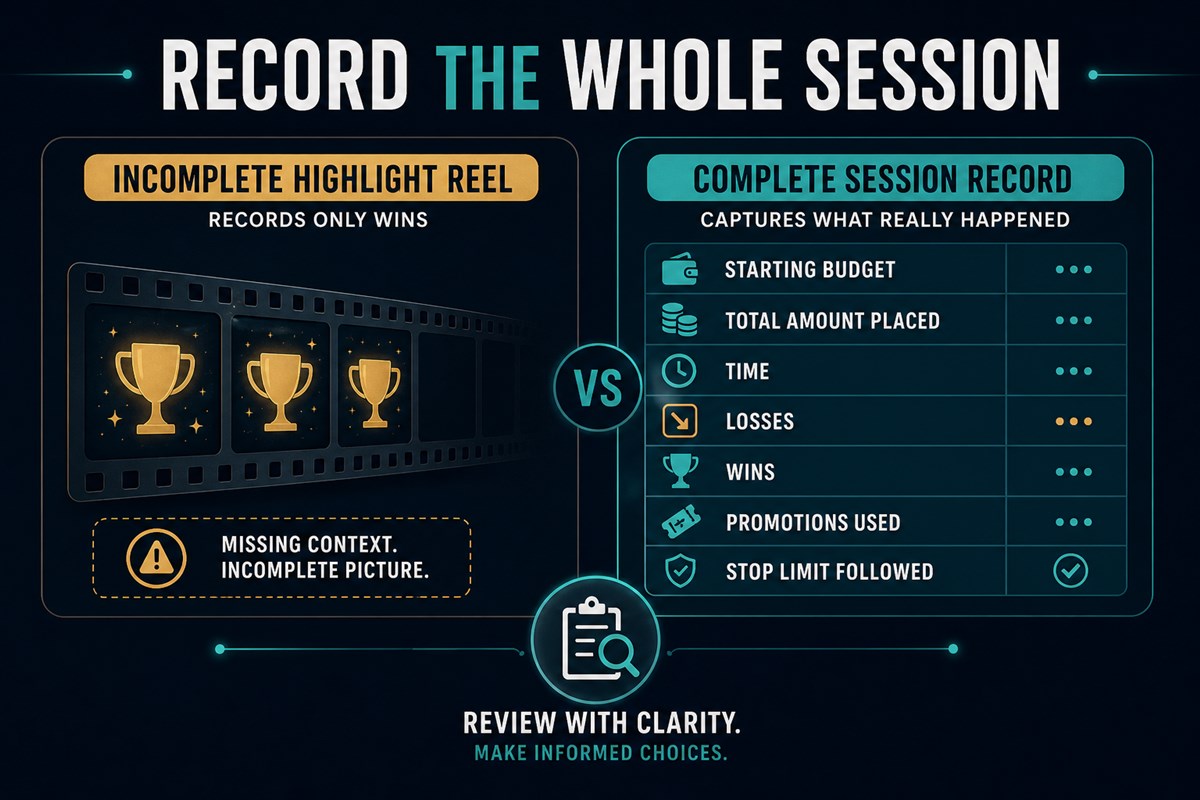
A player may remember a large withdrawal but forget the deposits that came before it. Bonuses can also make a balance look larger while adding wagering or withdrawal conditions. A useful record includes:
- every deposit and withdrawal;
- opening and closing balance;
- bonuses accepted and the complete terms;
- fees and cancelled or reversed transactions;
- session start and end time;
- money borrowed or moved from another budget;
- the reason you continued after a planned stop.
Review the net result over a meaningful period, not only a winning day. Do not convert a few favorable sessions into a monthly return claim.
Promotions Do Not Create Reliable Return
A bonus can have wagering, eligible-game, expiry, maximum-bet, cancellation, and withdrawal conditions. It can change the account rules without changing the uncertainty of the game.
Do not count a promotional balance as income. Read the current written terms before accepting an offer, and skip it when the conditions are incomplete or unclear. This guide gives no SuperAce88 bonus amount or eligibility claim.
Stopping After a Win Is Not a Business Model
Withdrawing a favorable balance can prevent that particular balance from being wagered again. It does not prove that the game created stable income, and it does not change the expectation of future wagers.
Do not set household plans around a future withdrawal. Essential obligations should be funded before gambling, not after a hoped-for result.
When to Use Help or Exclusion
Use a help path when gambling causes debt, unpaid bills, secrecy, relationship conflict, repeated attempts to recover money, distress, or difficulty stopping. Do not wait for a larger loss to make the concern “serious enough.”
PAGCOR publishes responsible-gaming and exclusion information. Its 2026 National Problem Gambling Helpline materials describe a current Philippines support route. If there is immediate danger or a mental-health crisis, contact local emergency or qualified health services.
An exclusion request, blocking tool, account closure, or conversation with a trusted person can create distance from the next impulse. These steps protect the person and household; they are not a punishment.
Frequently Asked Questions
Can disciplined casino play become reliable income?
No. Discipline can support a stopping rule, but it cannot make uncertain outcomes arrive on schedule or protect capital like a salary.
Does setting a daily win goal make results consistent?
A desired result does not change the game. It can also encourage continued play until the target is reached, increasing exposure.
Can money management guarantee recovery?
No. Changing stake size does not force a future win. Progression systems can make later wagers grow while funds and table limits remain finite.
What should I do if I used essential money?
Stop gambling transfers, protect the remaining essentials, tell someone you trust, and seek qualified financial or gambling-harm support. Do not gamble again to repair the shortfall.
Is SuperAce88 a source of income?
This guide does not describe SuperAce88 or any casino as income. Gambling is uncertain entertainment spending and can cause financial harm.
Sources
- World Health Organization: Gambling fact sheet
- PAGCOR Responsible Gaming
- PAGCOR: National Problem Gambling Helpline materials
- Responsible Gambling Council: Safer gambling tips
Prepared by superace88 Casino Guide 編輯室. This correction focuses on uncertainty, essential-expense protection, stop triggers, complete records, and help paths. It is not personal financial, clinical, or legal advice.