
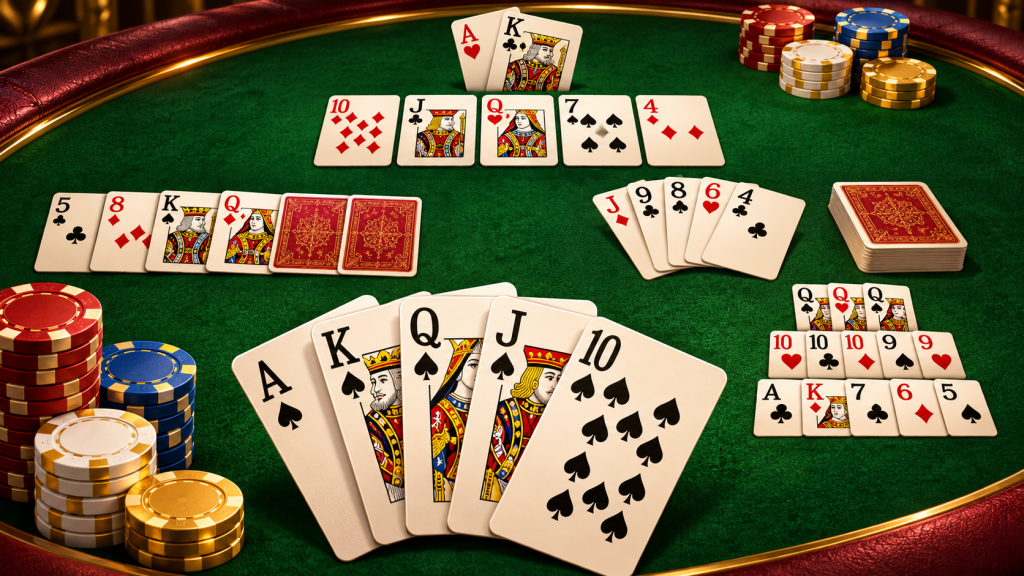
The card game of poker has many variations, most of which were created in the United States in the mid-1800s through the early 1900s. The standard order of play applies to most of these games, but to fully specify a poker game requires details about which hand values are used, the number of betting rounds, and exactly what cards are dealt and what other actions are taken between rounds.
This superace88 guide introduces the poker variations and formats below, with a comparison table and a standard hand-ranking chart to make the differences easier to follow.
Poker Variants at a Glance
| Game or format | Basic structure | Main distinction |
|---|---|---|
| Stud Poker | A mix of exposed and concealed cards | Players use their own dealt cards |
| High or Low Chicago | Stud-based split-pot home game | A qualifying hidden spade can win half the pot |
| Follow the Queen | Stud with changing wild-card conditions | Wild ranks depend on the agreed queen rule |
| Texas Hold’em | Two hole cards and five community cards | Best five-card hand from seven available cards |
| Countdown | Draw-poker home-game variation | Successive draws of up to three, two and one cards |
| Online Poker | Digital delivery format | Usually player-versus-player poker |
| Video Poker | Paytable-based draw game | Final hand is paid according to a schedule |
| Five-O Poker | Five simultaneous heads-up hands | Corresponding hands are compared |
| Tournament Play | Competition format | Players compete through increasing blind or ante levels |
| Let It Ride | Three private cards and two community cards | Remaining wagers are settled against a paytable |
| Chinese Poker | Thirteen cards arranged into three hands | Hand arrangement is central to play |
| Kuhn Poker | Simplified three-card game | A compact model for studying poker decisions |
For superace88 readers, separating poker variants from playing formats makes the list easier to understand: a tournament is a way to organize play, while Texas Hold’em is a set of card and betting rules.
Stud Poker: Five-Card and Seven-Card Variations
The foundation of many poker variations where the best poker hand wins, Games in which each player receives a combination of face-up cards and face-down cards in multiple betting rounds. The most common of these are five-card stud and seven-card stud. These two variants are further played in other different formats.
Often called Five Card Stud or Seven Card Stud – is a classic game that is also the foundation for other popular poker variations. Players are dealt a mix of face-up and face-down cards over multiple rounds of bets. In standard Seven Card Stud, the player with the lowest exposed card starts the first betting round with a bring-in. On later streets, the player with the strongest exposed hand acts first; subsequent players may check, bet, call, raise or fold as permitted by the action. At showdown, the player with the best qualifying five-card hand wins the pot, with tied winning hands sharing it.
What exactly is the best hand in stud poker? The ultimate poker hand is the Royal Flush, which are the five highest cards in the deck – 10, Jack, Queen, King and Ace – all in the same suit of spades, hearts, clubs or diamonds. A Straight Flush is any sequence of five cards in the same suit, the next strongest standard hand category below a Royal Flush. Other strong hands include Four of a Kind (four cards of the same rank, meaning a Jack of every suit for instance), a Full House (three of a kind plus a pair) and a Flush (five cards of the same suit).
While getting a hand like these may sound like luck, as you learn to advance your abilities to pay attention to which cards are being revealed, you get better at speculating what kind of hands other players may be holding and better at building your own. Your own bets – or bluffs – will be based on this kind of keen observation and strategy.
Standard High Poker Hand Rankings
| Rank | Hand | Description | Example |
|---|---|---|---|
| 1 | Royal Flush | A, K, Q, J and 10 of one suit | A♠ K♠ Q♠ J♠ 10♠ |
| 2 | Straight Flush | Five consecutive cards of one suit | 9♥ 8♥ 7♥ 6♥ 5♥ |
| 3 | Four of a Kind | Four cards of the same rank | Q♠ Q♥ Q♦ Q♣ 2♠ |
| 4 | Full House | Three of a kind plus a pair | J♠ J♥ J♦ 4♣ 4♠ |
| 5 | Flush | Five cards of one suit, not consecutive | A♦ J♦ 8♦ 6♦ 2♦ |
| 6 | Straight | Five consecutive cards, not all one suit | 8♠ 7♥ 6♦ 5♣ 4♠ |
| 7 | Three of a Kind | Three cards of the same rank | 7♠ 7♥ 7♦ K♣ 2♠ |
| 8 | Two Pair | Two separate pairs | K♠ K♥ 5♦ 5♣ 9♠ |
| 9 | One Pair | Two cards of the same rank | A♠ A♥ J♦ 8♣ 3♠ |
| 10 | High Card | No higher-ranked combination | A♣ J♥ 9♦ 6♠ 2♣ |
These are standard high-hand rankings. Lowball games, wild-card home games and special paytable games may use additional rules.
High and Low Chicago: A Stud-Based Split Pot
Either of these two versions can be played in any stud high game. In High Chicago, or sometimes simply called Chicago, the player with the highest spade face down (referred to as in the hole) receives half the pot. In Low Chicago, the player with the lowest spade in the hole receives half of the pot; the house rules specify how the ace ranks. If the player with the highest hand also has the highest/lowest spade in the hole, then that player receives the entire pot – having won both sides of the bet.
A different type of poker game to mix things up, sometimes called just High Chicago or Low Chicago – is a take on the popular poker card game of Seven Card Stud, named for the city that put it on the map in the poker world. Players are each dealt seven cards, and the goal is to have the best five-card hand.
The high or low distinction refers to the qualifying face-down spade, not to an eight-or-better low poker hand. The other half of the pot is still awarded to the best high poker hand. Agree on ace ranking, declarations and any additional house rules before the deal.
Follow the Queen: A Wild-Card Stud Variation
Follow the Queen is a Seven Card Stud home-game variation in which an exposed queen affects which cards are wild. In a common version, the next face-up card after a queen, together with every card of that rank, becomes wild. A later exposed queen can change the designated wild rank.
For example, if a queen is followed by a face-up seven, the sevens become wild under that rule. The queen’s suit does not make every card of the same suit wild.
Follow the Queen is a typical variant in Dealer’s Choice poker games. House rules differ on whether queens are always wild, what happens if the final exposed card is a queen, and what happens when no queen appears. The dealer should announce those conditions before the hand. Otherwise, the dealing and betting generally follow the agreed Seven Card Stud structure.
Texas Hold’em: Community Cards and Four Betting Rounds
One of America’s most popular poker games (aka Community Card Poker) – There’s an old song by Kenny Rogers that goes, “You’ve got to know when to hold ‘em, know when to fold ‘em.” He was singing the anthem of this style of poker. Texas Hold’em is widely associated with major poker tournaments, including the World Series of Poker.
In the game of Texas Hold’em, two cards are dealt to each player face down (their “hole cards”). The first betting round takes place before any community cards appear. The dealer then reveals three community cards together as the flop, followed by a betting round. One more community card is revealed as the turn, followed by another betting round, and a fifth community card is revealed as the river, followed by the final betting round.
The community cards remain on the table and are shared by all players. At showdown, each player makes the best five-card hand using any combination of their two hole cards and the five community cards. A player may use both, one or neither of their hole cards. A Royal Flush is the highest standard hand. Texas Hold’em combines hand selection, observation and decisions across its four betting rounds.
Countdown: A Draw Poker Variation
In the home-game version described here, Countdown is a variant of five-card draw with four rounds of betting. After the first round of betting, each player may choose to replace up to three cards. A second round of betting follows and then players may opt to replace up to two cards. Upon completing another round of betting, each player may replace one card in their hand. After a final round of betting, any remaining players show their hands, and the highest 5 card hand wins. When players draw cards to replace ones in their hand, they add the cost of the cards in the pot. The cost of cards doubles each round.
Because Countdown is a home-game variation, confirm the draw fees and betting structure with the group before play.
Online Poker and Video Poker: Understanding the Difference
Online poker and video poker are different formats. Online poker commonly brings players together at virtual tables to play games such as Texas Hold’em or Seven Card Stud. Players compete against one another under the rules of the selected variant.
Video poker is usually a paytable-based game derived from five-card draw. You do not compete against another player’s hand; the final hand is evaluated against the machine’s displayed payout table.
In a typical draw-style video poker game, after placing your bet, you’ll see five cards face-up on the screen. Here’s where some basic poker skills and experience will benefit the player, because next, you need to decide which cards to hold and which to let go. Use the draw control and your old cards will be replaced, just like if you were at the table. This hand determines whether you win against the payout table. The skill level advances based on which video poker variation you’re playing. The best part is practice versions may offer free play options to let you bone up on your skills.
For superace88 readers comparing digital formats, the key distinction is whether a game uses player-versus-player betting or a fixed paytable.
Five-O Poker: Five Hands in a Heads-Up Game
Five-O Poker is a heads-up poker variant in which both players must play five hands of five cards simultaneously. Four of the five cards in each hand are face-up. Once all five hands are down, there is a single round of betting. The winner is determined by matching each hand to the corresponding hand of the opponent. The player with the stronger poker hand in three (or more) out of the five columns, wins, unless a player folds on a bet that was made. If a player beats their opponent with all five hands, this is called a “Five-O” win.
Poker Tournament Play: Buy-Ins, Chips and Levels
From seasonal tournaments to the World Series of Poker, tournament play is not just for professionals. Just like any sport has its share of enthusiasts – college basketball with March Tournaments, football with the Playoffs – poker aficionados often love to test their skills during Tournament Play poker. Here’s how they work.
Tournaments typically have a buy-in to get a seat at the table and a limit on the number of players. Your buy-in gives you a set of chips to start with. Tournaments are structured in levels, with scheduled increases to blinds and/or antes depending on the poker variant. As levels advance, the forced bets rise relative to the chips in play. Individual hand pots and the tournament prize pool are separate concepts.
While you can find tournament play throughout the year in different variations of poker (see casino promotions for example), the best-known poker tournament series is the World Series of Poker (WSOP).
Let It Ride: Poker Hands Against a Paytable
Let It Ride is a poker-based casino table game that uses familiar five-card hand rankings. Players do not compete against another player’s hand or a dealer’s poker hand. Instead, the final hand is evaluated against the posted paytable.
The player places three equal bets in the marked betting circles. The dealer deals three cards to each player and places two community cards face down. After checking their own cards, the player may withdraw the first bet or let it ride. The dealer reveals the first community card, and the player may then withdraw the second bet or leave it in play. The third bet remains in action.
After the second community card is revealed, the player’s three cards and the two community cards form the final five-card hand. A pair of tens or better commonly qualifies for a payout on the remaining main wagers. Any optional bonus wager has its own qualifying hands and payout schedule.
Chinese Poker: Arranging Thirteen Cards
Chinese poker is a 2 to 4 player poker game with thirteen cards. The idea is to make three poker hands with increasing rank: two with five cards and one with three cards. If one of the hands does not adhere to increasing rank (i.e. is mis-set), the hand is declared dead and results in some sort of penalty.
Kuhn Poker: A Simplified Game Theory Model
Kuhn poker, using a three card deck, is more of game theory problem than an actual game people play, but it can be played by two players.
Understanding the Differences Between Poker Games
Poker games differ in how cards are dealt, how hands are formed and how winners are determined. Stud games reveal part of each player’s hand, community-card games share cards across the table, and draw games allow card replacement. Video poker and Let It Ride use paytables, while tournaments organize competition under the rules of a selected poker variant.
For superace88 readers exploring these formats, the comparison table provides a starting point, while each game’s own rules explain the exact betting structure, special conditions and hand evaluation.