
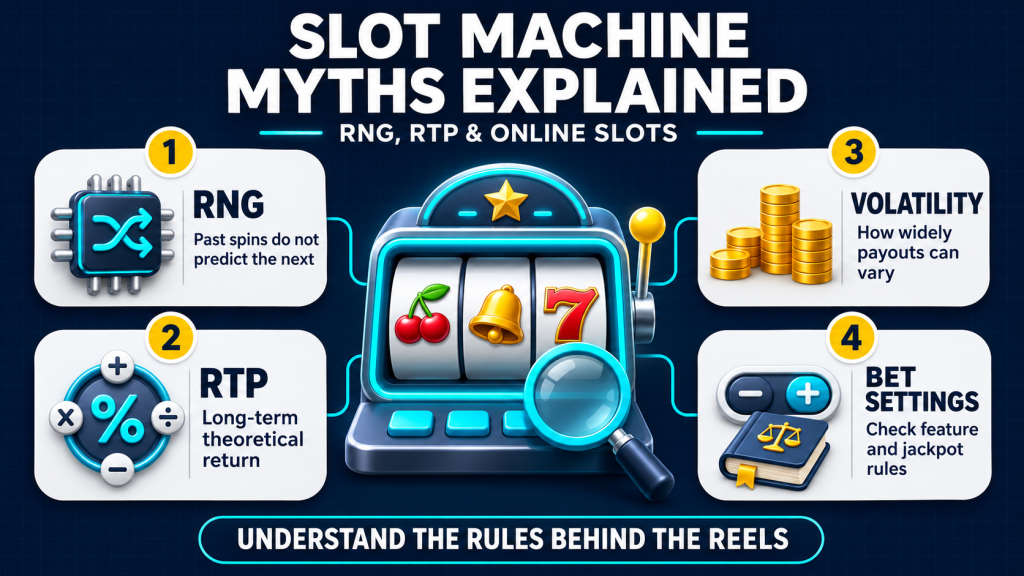
Slot machine myths often begin with an observation that feels meaningful: a game pays several times in a row, a bonus takes longer than expected, or a jackpot appears just after someone stops playing. The observation may be accurate, but the explanation attached to it can be misleading.
This superace88 guide examines the most common beliefs about slots and explains the mechanics behind them. Understanding random number generation, return to player, volatility and feature rules makes it easier to distinguish a game’s actual design from patterns that only appear in a short session.
Common Slot Machine Myths at a Glance
| Common belief | More accurate explanation |
|---|---|
| A cold slot must pay soon | Previous losses do not make an independent random spin due for a win |
| A recent jackpot makes another impossible | A previous award alone does not establish the next result’s probability |
| A 96% RTP means getting ₱96 back from every ₱100 session | RTP is a long-run theoretical return, not a session repayment rule |
| Maximum bet always improves the odds | The effect depends on the game’s bet settings and feature eligibility rules |
| A featured lobby position means higher payouts | Display placement does not establish the game’s mathematical configuration |
| More ways always means a better return | Winning structure and theoretical return measure different things |
| A near miss means a bonus is getting closer | Visual proximity is not evidence of improving odds on the next independent spin |
These explanations concern conventional RNG-based slots. A declared bonus state, collection feature or jackpot mechanism may introduce additional rules that need to be considered separately.
How Online Slots Work Behind the Reels
An online slot combines random inputs with a mathematical model that determines symbol combinations, feature triggers and awards. The reel animation presents the result; the artwork alone does not reveal the probabilities behind it.
Two games can display similar symbols while assigning different probabilities or payouts to their combinations. Counting the pictures visible on a screen is therefore not enough to calculate the game’s RTP.
RNG Determines Random Selections
A random number generator supplies inputs used by the game software. The software maps those inputs to outcomes under the relevant rules. Randomness does not mean that every possible prize has the same probability.
For ordinary independent spins under unchanged rules and the same game state, a sequence of previous wins or losses does not create a requirement for the next spin to compensate. The UK Gambling Commission distinguishes random play from compensated machine designs in its explanation of machine returns.
A Bonus Can Have Different Rules
Free spins, growing multipliers, sticky symbols and collection meters can change what is active on screen. That is different from a game secretly adjusting its probabilities because an individual has won or lost recently.
As a technical reference, the UK regulator’s randomness standard prohibits adaptive compensation while allowing properly described bonus features with different rules. It is a useful distinction between a declared game mechanism and an imagined hot-or-cold cycle.
Myth 1: A Losing Streak Makes a Slot Ready to Pay
This belief treats a slot as though it keeps a personal repayment schedule. A series of losing spins is interpreted as a buildup that must end with a larger award.
For independent random spins, that conclusion does not follow. If an event has a fixed probability of 1 in 100, failing to observe it on the previous spin does not automatically turn the next probability into 1 in 99.
This is different from a game that explicitly records progress toward a feature. If the rules say collected tokens persist, the displayed collection state may matter. The useful question is whether there is a documented state change, rather than whether the game has simply been quiet.
Myth 2: RTP Forces a Game to Correct Its Recent Results
A 96% RTP does not require a game to alternate between generous and restrictive periods to deliver exactly 96% during every session. It describes the theoretical return of the mathematical model across extensive play.
The distinction matters when comparing theoretical RTP with observed RTP. An observed figure is calculated from actual awards and turnover over a chosen sample. It can be above or below the design figure without establishing that the software changed its settings.
| Measurement | Meaning | What it does not establish |
|---|---|---|
| Theoretical RTP | The designed long-run return percentage | A fixed return in a short session |
| Observed RTP | Awards divided by turnover over a measured sample | The exact configuration from a small sample alone |
| Volatility | How widely results can vary within the payout distribution | A scheduled sequence of wins and losses |
| Hit frequency | The share of plays producing a qualifying award | How often the award exceeds the stake |
A Simple Peso Example
Applying 96% to ₱10,000 of turnover produces ₱9,600 as a theoretical illustration. Turnover means total stakes, including winnings that are staked again; it is not necessarily the initial deposit. The calculation does not predict what one person’s ₱10,000 session will return.
For superace88 readers comparing online slots, RTP and volatility answer different questions. RTP describes an average return ratio, while volatility helps explain how unevenly awards may be distributed.
Myth 3: A Jackpot Becomes Due After a Long Wait
For a jackpot with a fixed independent trigger probability, elapsed time or a long run without an award does not by itself improve the chance on the next eligible spin. A recently awarded jackpot also does not automatically prevent another one.
However, jackpot systems are not all identical. Some have a growing prize amount, stake-dependent eligibility or a disclosed must-hit-by mechanism. A larger displayed pool establishes its current value; whether it affects the chance of winning depends on the actual design.
| Jackpot detail | What to check |
|---|---|
| Trigger mechanism | Whether the award is symbol-based, randomly allocated or governed by another stated condition |
| Eligibility | Whether a minimum stake, contribution or optional setting is required |
| Prize growth | How contributions increase the pool |
| Reset behavior | What happens to the prize after an award |
| Disclosed ceiling | Whether a maximum value or other must-hit condition exists |
Jackpot rules are therefore more informative than a timer showing how long ago the last prize was awarded. Technical guidance on progressive systems also treats funding, award rules and eligibility as distinct information.
Myth 4: Maximum Bet Always Gives Better Odds
In a game where changing the stake only scales awards proportionally, a higher bet increases the monetary size of both the stake and corresponding prizes. It does not automatically improve the chance of landing a particular symbol combination.
Other games offer settings that change more than the stake amount. An extra-bet mode might modify feature access, a jackpot might have an eligibility threshold, or a bonus purchase might use a separate entry mechanism. Those options need their own rules and, where supplied, their own RTP information.
The comparison should therefore be between defined modes, not simply between the smallest and largest numbers on the bet selector.
Read the Stake Reference Carefully
A payout expressed as 20x total bet is different from 20 credits. If the total bet is ₱2, a 20x-total-bet award equals ₱40. If the paytable uses credits, the credit value must be known before converting the award into pesos.
Myth 5: Time of Day or Lobby Position Identifies Better Slots
The original casino-floor theory suggests that machines near entrances or aisle ends must pay more. Its online equivalent is the assumption that a game at the top of a lobby must have better odds.
A lobby position may reflect promotion, personalization or a chosen display category. None of those labels, by itself, establishes RTP, symbol probabilities or jackpot eligibility. A “popular” label and a mathematical specification describe different things.
Likewise, an evening win and an afternoon loss do not establish a daily payout schedule. To support that claim, a reader would need evidence about the specific game’s rules or configuration, rather than a handful of results.
This does not mean every implementation of a title must use identical settings. The relevant comparison is the version and rules actually offered. As an example of regulated practice, UK technical standards require material changes to rules, payouts or outcome probabilities to follow defined change procedures; they should not be confused with ordinary session variation.
Myth 6: Spin Timing, Turbo Mode or a Device Switch Improves Results
Pressing spin at a particular second is not a dependable method for selecting a favorable RNG outcome. Nor should every online implementation be explained through the physical-machine claim that a button press captures one specific microsecond of a continuously running local generator.
Online architectures differ. The practical point is that a player-facing animation does not reveal a usable method for predicting the random selection.
Where an animation-speed option exists, faster presentation alone does not demonstrate a change in the game’s probabilities. Similarly, changing screen orientation or using a larger display is an interface choice, not evidence of a better payout model. Compare the actual game version if settings differ across devices.
Myth 7: Loyalty Status Changes the Reels
An account reward and a slot outcome are separate mechanisms unless the game explicitly connects them. Cashback, loyalty points or a promotion may change the overall offer without changing the underlying probability of a symbol combination.
The superace88 way to assess such claims is to separate the game’s paytable and RTP from the promotion’s terms. A reward may have value on its own; that does not make it evidence that the reels have become more generous.
Myth 8: More Paylines or Ways Means a Higher RTP
Paylines and ways describe how combinations are evaluated. RTP depends on the probabilities and awards of the complete game, including its features.
A game with thousands of ways can have the same theoretical return as a game with a small number of lines. Differences in volatility, feature design and the distribution of prizes may still make them feel very different to play.
| Structure | What it describes | Useful detail to examine |
|---|---|---|
| Fixed paylines | Defined paths used to evaluate symbols | Matching counts and payout values |
| Ways to win | Qualifying combinations across reel positions | Direction, consecutive-reel rules and symbol multiplicity |
| Cluster pays | Qualifying connected groups of symbols | Minimum group size and connection rules |
| Cascading reels | Replacement of symbols after qualifying results | How successive results and multipliers work |
These categories can overlap. A game may use both ways evaluation and cascading symbols. Neither label independently establishes its return percentage.
What Is Actually Useful When Comparing Online Slots?
Replace assumptions about timing and streaks with details that can be checked. The most useful starting points are the exact title, the game information panel and the rules for any optional mode.
- Confirm the title and version. Similar names and sequels may represent different games.
- Read the displayed RTP. Check the setting relevant to the mode being compared.
- Examine volatility and features. Consider how ordinary combinations, bonuses and multipliers contribute to the experience.
- Check payout units. Distinguish credits, total-bet multiples and monetary awards.
- Separate game rules from promotions. Jackpot access, free-spin offers and loyalty rewards may have different conditions.
Accessible rules and payout information are also central to the UK regulator’s game-description standards. These sources explain technical concepts; they do not establish the licensing or compliance status of a particular website.
Frequently Asked Questions About Slot Machine Myths
Can a slot be hot or cold?
The words can describe a recent sequence of results. They do not establish that an independent random game’s next-spin probabilities have changed.
Does a near miss mean a bonus is close?
Not on the basis of visual proximity alone. A documented collection meter or persistent feature state is different because the rules specify what progress means.
Can two slots have the same RTP but different gameplay?
Yes. The same average return can be distributed across different prize sizes and frequencies, producing different volatility and feature experiences.
Can a demo prove what a paid session will return?
A demo can help explain controls, symbols and feature presentation. A short sample cannot establish a future session result or reliably measure the theoretical return.
Are all slot outcomes equally likely?
No. Random selection can produce outcomes with different probabilities. Equal-looking symbols or equally large spaces on a visual display do not necessarily represent equal chances.
Understanding Slots Through Their Actual Mechanics
Slot machine myths become easier to assess when each claim is connected to the mechanism it would require. A losing streak concerns past results, RTP concerns the mathematical return, and a bonus meter concerns a documented game state. Keeping those ideas separate produces a clearer explanation of how online slots work.
This superace88 overview provides a practical basis for comparison: examine the rules, identify the relevant configuration and read each statistic according to what it measures. That approach makes game analysis more informative than relying on payout rumors or patterns inferred from a few spins.


