Quick answer: a live score, stream, and betting screen can all show different moments. A live betting delay does not by itself prove that a wager was accepted late or settled incorrectly. Start with the accepted bet record, its timestamp and odds, then compare the exact market rule, the named result source, the settlement calculation, and the balance entry.
Do not place the same wager again while the first one still shows a spinner or an unclear status. First confirm whether it was accepted, rejected, or left pending. Repeating it can create a second valid exposure rather than fix the first uncertainty.
First Separate the Five Clocks
When an in-play price moves or a market closes, people often compare one clock on a television screen with another clock on a betting interface. That comparison is incomplete. Reconstruct five separate timelines:
| Clock or record | What it represents | Evidence to keep |
|---|---|---|
| Event clock | What happened at the venue and when | Official play-by-play or event report |
| Broadcast clock | When the action reached the TV or stream | Provider, screen time, and a note that the feed may be delayed |
| Data-feed clock | When a score or event update reached the interface | Displayed score and time, if captured lawfully |
| Market clock | When odds changed or the market became suspended | Market name, offered odds, and visible state |
| Acceptance record | Whether and when the operator accepted the wager | Bet ID, accepted timestamp, odds, stake, and status |
The UK Gambling Commission’s in-play guidance explains why these clocks can diverge: people at a venue may receive information before viewers watching a broadcast, and a betting operator may apply a processing delay before confirming an in-play wager. Its technical standard requires operators within its scope to warn that a “live” broadcast can be delayed. That is useful background about latency, not evidence that a particular licence or rule applies to this website.
A Suspended Market Is Not the Same as a Rejected Bet
A market can be suspended while an operator processes new information, changes a price, or checks an event. But the word “suspended” describes the market’s availability at that moment; it does not tell you what happened to every submission made around that time.
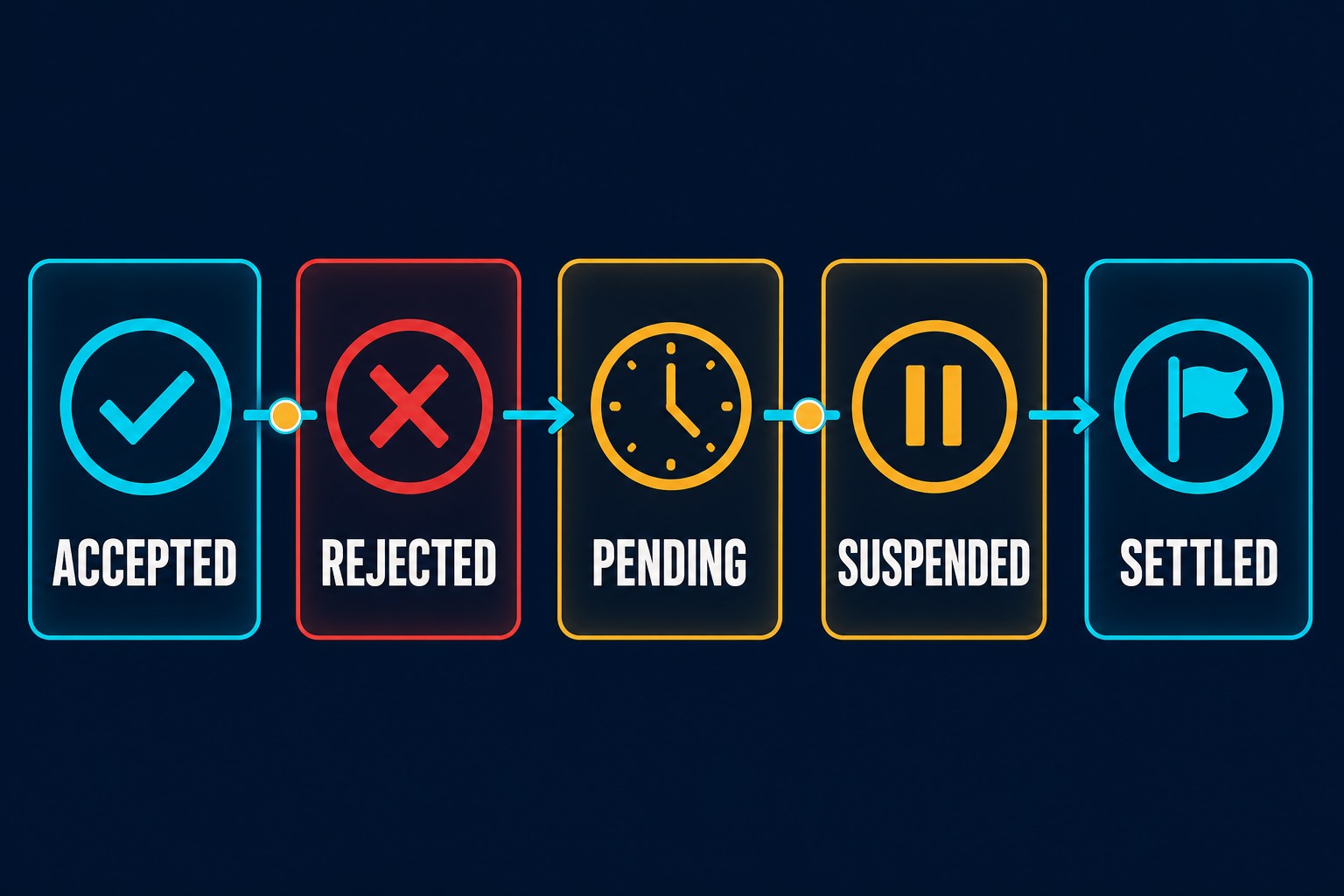
| Status | Practical meaning | Next check |
|---|---|---|
| Accepted | A wager record was created at stated odds | Save the complete slip and accepted time |
| Rejected | The proposed wager was not accepted | Confirm there is no bet ID and no stake debit |
| Pending | The final acceptance state is not yet shown | Wait, refresh the bet history once, and avoid duplicating it |
| Suspended | New selections may be temporarily unavailable | Check the status of the specific submitted wager |
| Settled | A grading result and balance effect were applied | Audit the result source, rule, and calculation |
Betfair’s current Sportsbook rules, for example, warn its own customers that displayed live scores and elapsed time may be delayed or inaccurate, and that its settlement rules still apply. Those are Betfair rules only. DraftKings’ current rules provide another operator-specific example: its in-play submissions may be subject to a delay before acceptance. The difference between these published terms is precisely why a dispute should quote the rule governing the actual slip.
Build a Minute-by-Minute Evidence Timeline
Consider this hypothetical sequence:
- 20:14:08 — a viewer sees the score at 0–0 on a stream.
- 20:14:11 — the viewer presses “place bet” at displayed odds of 2.10.
- 20:14:13 — the betting screen shows “pending.”
- 20:14:14 — a goal appears on the stream.
- 20:14:16 — the market shows “suspended.”
- 20:14:18 — the bet history records acceptance at odds of 2.10.
This sequence alone does not establish whether the wager should stand. The stream may have shown the goal seconds after the venue event, while the operator’s data feed and acceptance system may have recorded different timestamps. The correct review asks: what time did the event occur in the official data, when was the bet accepted, what did the applicable late-bet or error rule say, and what settlement action followed?
Keep the original accepted slip rather than relying only on a screenshot of the market. A market screenshot may show what was visible, but it may not prove what the operator accepted.
What Market Suspension Can and Cannot Prove
A suspension can be consistent with many situations: a goal, card, injury, review, timeout, lost data feed, or manual trading decision. It may occur before, during, or after a material event reaches a viewer’s screen. It can also affect related markets differently.
Therefore, none of these statements is safe without the actual record:
- “The market suspended, so my bet was definitely rejected.”
- “The slip exists, so the odds can never be reviewed under an error rule.”
- “The video still showed the old score, so every displayed price had to remain valid.”
- “One related market stayed open, so all connected markets had to stay open.”
The UK regulator’s published-rules condition, for operators under its authority, requires rules to cover core acceptance and settlement matters such as errors and late bets. It also requires an electronic acknowledgement for a transaction. That supports an evidence-first method: identify the acknowledgement and the applicable written rule instead of inferring a result from screen behaviour.
Save This Evidence Before Contacting Support
- complete bet ID and accepted slip;
- event, competition, market, selection, line, and time scope;
- stake, accepted odds, accepted time, and timezone;
- the status sequence: pending, accepted, rejected, suspended, or settled;
- official event time and result source named by the rule;
- the version of the house, sport, in-play, error, and settlement rules that applied;
- settlement calculation and matching balance entry;
- support ticket and any later correction.
Capture only what you can access lawfully. Redact unrelated bets, identity documents, payment details, and account balances before sharing evidence. A support agent does not need your password, one-time code, PIN, recovery phrase, or remote access to review a bet ID.
Ask One Precise Question, Not Five Separate Complaints
Hello. Please review in-play bet ID [ID] for [event]. The exact market and selection were [text], accepted at [time and timezone] at [odds]. My bet history shows [status], while the settlement entry shows [result and amount]. Please identify the acceptance timestamp used, the event or official-data timestamp used, the applicable in-play/error/settlement rule, and the calculation that produced the balance entry.
Attach the accepted slip and a privacy-safe balance record. If support answers only with a generic label, ask which rule section and result source were applied. Keep the conversation in one ticket so the evidence chain remains chronological.
Use a Pause Rule for In-Play Decisions
Fast-moving markets can encourage repeated taps and immediate attempts to recover a perceived loss. A safer rule is simple: if the acceptance state is unclear, stop. Do not increase the stake, open a second account, or use another market to “cancel out” the first wager.
Only adults who are legally permitted to gamble should use betting services. Treat every stake as money that can be lost, set limits before the event, and stop if gambling affects food, housing, bills, debt, medicine, work, sleep, or relationships. A disputed result is an accounting question, not a reason to chase losses.
For more provider-neutral sports-betting explainers, visit the Sports Betting guide archive.
Frequently Asked Questions
Why did the market suspend before I saw anything happen?
The operator’s event data may arrive before a broadcast or stream. Suspension can also follow a review or trading decision. The suspension time alone does not prove whether your particular wager was accepted.
Does a bet ID prove the wager must be paid as shown?
A bet ID is important acceptance evidence, but settlement still depends on the applicable market, error, event, and result rules. Ask for the rule and calculation if the outcome is disputed.
Should I place the same bet again if the first one is pending?
No. Wait until the first acceptance state and balance entry are clear. A second submission may become a separate accepted wager and double the exposure.
Is a live-score app enough evidence for a dispute?
It can help reconstruct what you saw, but the rule may name a different official result or data source. Pair it with the accepted slip, applicable rules, and official event record.
Reference Sources
Sources checked 3 August 2026. Operator rules can change, so use the version governing the actual accepted bet.
- UK Gambling Commission: RTS 15 — In-play betting
- UK Gambling Commission: in-play or in-running betting
- UK Gambling Commission: display of rules — betting
- Betfair Sportsbook: general sports betting rules (third-party rule example)
- DraftKings Sportsbook: general betting rules (third-party rule example)
Editorial disclosure: Prepared by the SuperAce88 Editorial Team. This article explains an evidence-checking method. It does not confirm SuperAce88 settlement rules, regulatory status, platform safety, or the outcome of any individual dispute, and it does not replace the terms governing an accepted wager or applicable law.