
Quick answer: the rule that matters is the version that governed the wager when it was accepted, not automatically the page you happen to open today. Preserve the accepted ticket, exact market wording, source URL, document title, version or “as of” date, effective date, relevant paragraph, precedence clause and capture time. Then compare any later revision separately. If the public page has no history, ask verified support to identify the exact rule version and hierarchy used for that ticket.
Make a rule receipt: acceptance timestamp → market and bet-slip wording → rule document and effective/as-of date → applicable section and precedence → later revision. This is an evidence workflow, not a claim that any operator must use a particular hierarchy or that a dispute will be decided in your favour.
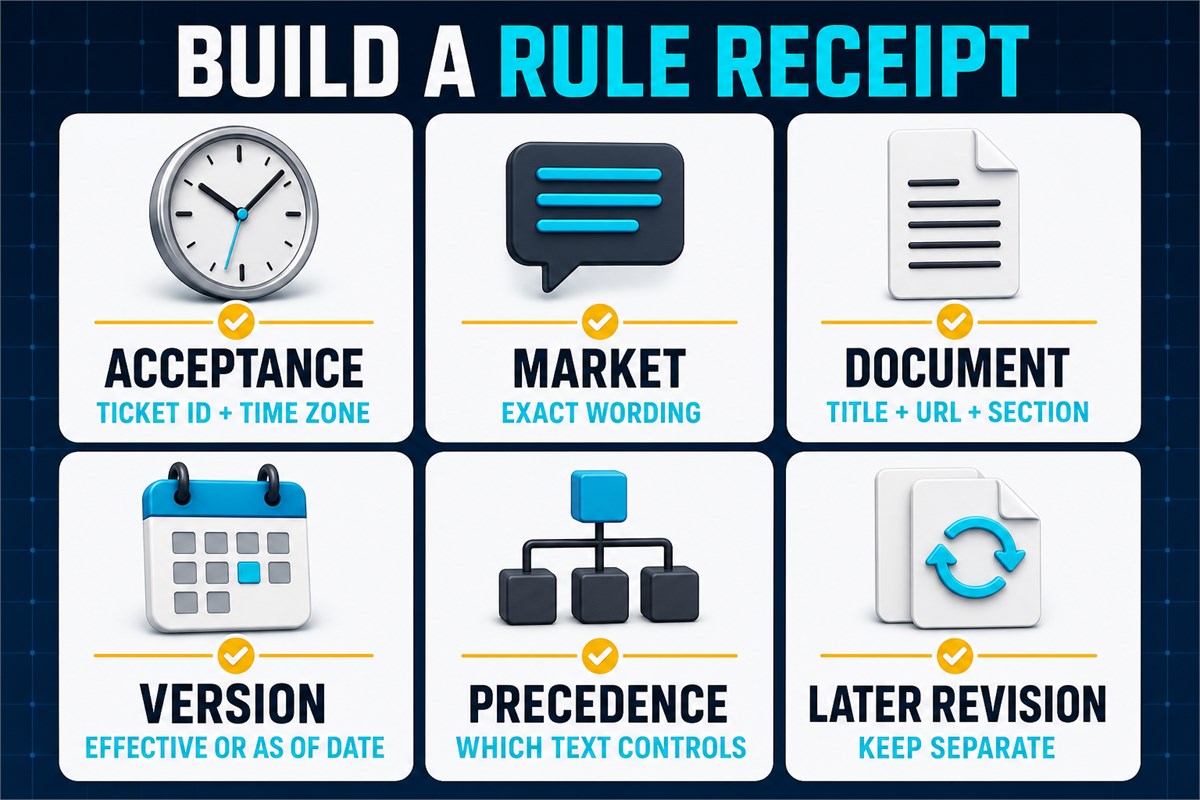
Why the displayed page may not be the historical rule
Sportsbook rules can contain general terms, sport-specific rules, market definitions, bet-slip notes and event-status clauses. A page can be edited after your wager is accepted. A “last updated” label can describe the web page rather than the effective date for a bet. A current help article can also summarise a rule without showing the wording that applied at the earlier acceptance time.
Current operator examples show why a reader should preserve the hierarchy rather than copy it. Fanatics’ house-rules page displayed an effective date of 4 August 2026 and says posted revisions govern wagers accepted after posting, while sport-specific rules take precedence over general rules where they vary. DraftKings’ New Jersey rules are another operator and jurisdiction example with separate general, market and sport sections and precedence language. Neither example is a SuperAce88 rule, a Philippines rule or evidence of a particular settlement.
An Ohio administrative rule is a regulator example that sportsbook house rules should address calculations, scheduling, cancellations, incorrect results, notifications, complaints and disputes. It does not establish Philippine regulatory coverage, licensing or applicability. The safe lesson is narrower: identify the document and its date, then use the operator’s own precedence wording instead of inventing a universal order.
Record the accepted ticket first
Start with the ticket or receipt, not the rule page. Save the acceptance date and time with the displayed time zone, event and market title, selection, odds format, stake, bet type and any market note. If the bet slip contains a shortened rule link, capture that link and the exact text surrounding it. Do not rely on a memory of the page or an image without a URL and capture time.
| Rule-receipt field | What to record | Why it matters | Example of a safe note |
|---|---|---|---|
| Acceptance | Ticket ID, accepted timestamp and time zone | Anchors the version question to the transaction | “Accepted 2026-08-10 14:03 PHT; ticket ID copied exactly.” |
| Market wording | Event, market title, selection and bet-slip notes | Market-specific text may narrow a general rule | “Two-way total; bet slip shows ‘regular time’ note.” |
| Document identity | Rule title, operator/jurisdiction, URL and section | Prevents a later summary being mistaken for the controlling text | “Sport Rules, Section 4, URL captured independently.” |
| Version date | Effective date, version number or as-of date; never invent a blank field | Separates applicable text from later revisions | “Effective date not displayed; support asked to identify historical version.” |
| Precedence and capture | Conflict clause, relevant paragraph, capture time and file hash/name | Shows how competing documents should be compared | “Sport-specific clause says it overrides general rule; capture 14:11 PHT.” |
Find the document hierarchy without assuming it
Read the page in layers. First locate the market or sport rule named by the ticket. Then locate any general settlement rule, terms of use, event-status clause and bet-slip note. Look for phrases such as “takes precedence,” “subject to,” “unless otherwise stated,” “as of,” “effective,” or “accepted after posting.” Record the clause, not just your interpretation.
A conflict table helps show what still needs to be verified. The rows below are a method, not a universal order. The correct result depends on the current operator’s own wording and the product’s applicable jurisdiction.
| Document or wording | Question to ask | Evidence to preserve | Do not assume |
|---|---|---|---|
| Bet slip or market note | Does the accepted ticket add a time scope, participant or exception? | Exact rendered wording and ticket ID | That a later generic help page replaces it. |
| Sport-specific rule | Does it state a special result, postponement or correction rule? | Section title, version/date and paragraph | That another sport’s clause transfers across markets. |
| Market/settlement rule | How are the selected market and result defined? | Definition, cutoff and source link | That “official result” has one universal source or time. |
| General rules or terms | What conflict or precedence clause applies? | Exact clause and document date | That the newest page automatically governs an older ticket. |
| Later revision or support reply | Was the change posted after acceptance, and is it only a summary? | New URL, capture time, reply wording and reference | That a screenshot alone proves completeness or applicability. |
Separate later revisions from the original rule
Keep two files or clearly separated sections: rule at acceptance and later rule or explanation. Add the date each was captured and the source URL. If a result was corrected after settlement, record the correction as a separate event; do not silently overwrite the original receipt. This makes it possible to ask whether the correction changes the result, the settlement rule or neither.
If no effective date or archive is visible, write “not displayed” rather than inferring one from the page’s copyright year. Ask support: “Which rule document and version applied to ticket [ID] accepted at [time zone], and which precedence clause did you use?” Request the section title and URL. A reply that only says “current policy” does not answer the historical-version question.
The existing live-betting delay and suspended-market guide is a useful next step when the acceptance timestamp or in-play status is the uncertainty. For vocabulary, the published sports terminology explainer can provide context, but it does not supply a product-specific historical rule; the rule receipt remains the primary evidence task.
Use sources without importing their rules
When citing a foreign operator or regulator, name the jurisdiction and use it for method or comparison only. A Fanatics effective date demonstrates why a date field is useful. DraftKings’ document structure demonstrates why precedence must be located. Ohio’s regulator text demonstrates the kinds of subjects a house-rule document may address. None proves the SuperAce88 licence, regulator status, market availability, official data provider, settlement outcome or historical page content.
Stop conditions and privacy
- Stop before making a conclusion when the ticket ID, acceptance time or market wording is missing.
- Stop when a page has changed but no effective/as-of date or archived copy is available; ask support for the historical version.
- Stop when a message asks for a password, OTP, recovery phrase or unrelated identity data. Navigate independently to a known official route.
- Stop when a screenshot contains other customers’ data, full payment credentials or unrelated tickets; redact before sharing.
- Do not increase stakes, place another wager or chase a disputed outcome while the rule and evidence are unresolved.
Frequently asked questions
Can sportsbook rules change after I place a bet?
They may be revised, but whether a revision applies depends on the operator’s wording, posting time, jurisdiction and the bet’s acceptance time. Preserve the earlier receipt and ask which version governed it.
Which date matters: acceptance, event or settlement date?
Start with acceptance because the question is which rule governed the wager when it was accepted. Event and settlement dates can matter for a specific clause, so record all three when available.
Is a screenshot enough?
A screenshot preserves what was visible, but it may not prove completeness, authenticity or applicability. Keep the URL, document title, capture time, effective/as-of date and relevant paragraph with it.
What if the page has no effective date or archive?
Write “not displayed,” save the current page and ask verified support for the historical document or version tied to the ticket. Do not infer a date from a copyright notice or search-result snippet.
Which rule wins when market notes and a general rule conflict?
Locate the operator’s own precedence clause. A market or sport rule may have priority, or the bet slip may contain a specific exception, but this cannot be assumed across operators or jurisdictions.
Sources and editorial disclosure
- Fanatics Sportsbook House Rules — effective-date and posted-revision example from a Washington, D.C. operator rulebook.
- DraftKings Sportsbook General Rules — New Jersey operator example with separate general, market and sport rule sections.
- Ohio Administrative Code Chapter 3775-10 — regulator example of topics addressed by sports-gaming house rules and dispute procedures.
Source note: sources were checked on 10 August 2026. Fanatics and DraftKings examples are operator- and jurisdiction-specific; Ohio is a regulatory example. None establishes SuperAce88’s rule version, effective date, licence, regulator coverage, official result source or settlement outcome. Preserve the current product wording and seek an authenticated historical record before making a dispute claim.