Quick answer: full-game basketball moneyline, spread, and total markets often include overtime, while regulation-only and quarter markets can stop earlier. These basketball bet time rules depend on the exact market label and the house rule attached to the accepted bet, so “often” is not enough to add or exclude overtime points.
When regulation ends tied, three scores may matter: the score at the end of regulation, the score for a named quarter or half, and the final score after overtime. A basketball bet time-rules review must identify which one the selected market promised to use.
Use Basketball Bet Time Rules to Map the Official Game Clock
League structure provides the timeline, not the answer to every bet. The NBA’s official Rule No. 5 states that regulation has four 12-minute periods and overtime periods last five minutes. FIBA’s 2024 Official Basketball Rules state that a game has four 10-minute quarters and, if tied after the fourth quarter, continues with as many five-minute overtimes as needed to break the tie.
Those official facts prevent a common mistake: treating the NBA, FIBA, 3×3, college, youth, and special tournament formats as interchangeable. Confirm the competition before checking the market. A scoreboard labeled “Final/OT” is evidence that overtime occurred, but it does not tell you whether the selected bet included it.
| Market scope | Possible controlling endpoint | What to verify on the slip and rule |
|---|---|---|
| Full-game moneyline | Final result, often including overtime | Whether it is two-way, three-way, or explicitly regulation only |
| Full-game spread or total | Final counted score, often including overtime | Overtime clause, accepted line, push or tie rule |
| Regulation-time result | End of the fourth quarter or stated regulation period | Whether draw was offered and whether overtime is expressly excluded |
| First half | Halftime score | Exact half and completion requirement |
| Second half | May or may not include overtime | The operator’s definition; do not infer it from the words “second half” |
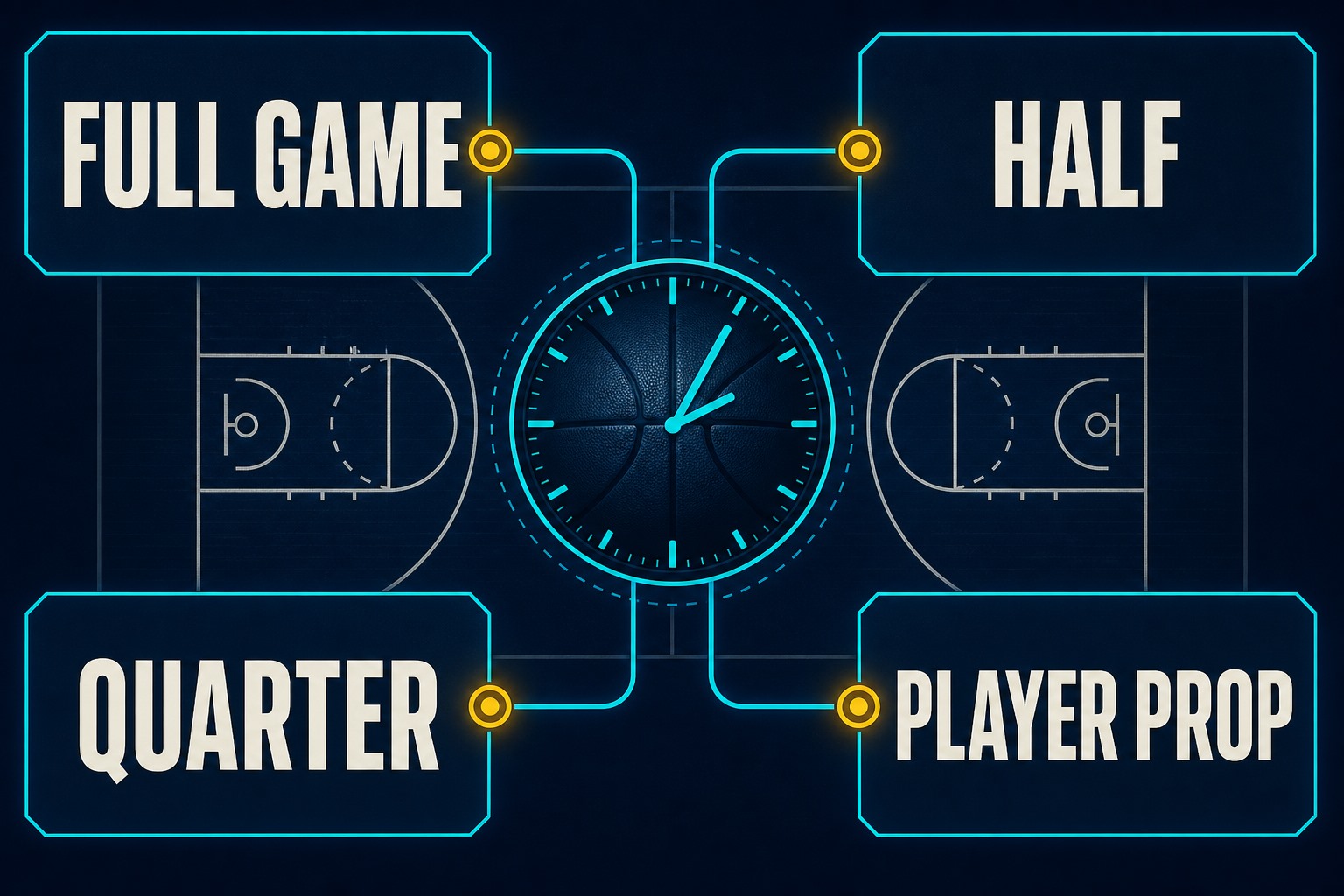
| Quarter market | End of the named quarter | Whether that full quarter must finish and whether any exception applies |
| Player proposition | Official statistic in the stated game or period | Participation rule, time scope, overtime treatment, official data source |
The Market Label Determines Which Clock Counts
Copy every word from the accepted slip: competition, teams, market, selection, period, line, odds, and acceptance time. “Home -3.5” is incomplete without knowing whether it was full game, regulation only, first half, or a quarter. “Player over 24.5 points” is incomplete without the participation and overtime rules.
Look for these labels:
- Including overtime or OT included points to the final counted score.
- Regulation time, normal time, fourth-quarter result, or a three-way market with draw may stop before overtime.
- First half, second half, and quarter require the operator’s period definitions.
- To qualify or series winner can cover a different outcome from a single-game moneyline.
If the slip is abbreviated, use the archived market detail and current house-rule hierarchy. Save the rule version because an operator may update it after the bet was accepted.
Why “Second Half” and “Fourth Quarter” Need Extra Care
Current third-party rules demonstrate real variation. DraftKings’ basketball page says most bets include overtime but lists exceptions. It also says its fourth-quarter player-points markets exclude overtime, while some second-half or fourth-quarter market categories on that page include overtime. Betfair’s current Sportsbook basketball page says US-basketball second-half markets include overtime, but Euro/other-basketball second-half markets exclude it; its quarter markets exclude overtime.
Those details apply only to the named operator, product, jurisdiction, sport section, and current rule version. They are included here to show why a generic answer from a forum or search snippet is unsafe. For a SuperAce88 ticket, only the SuperAce88 rule and accepted market record can establish the result.
Work Through a Tie at Regulation
Assume a hypothetical game is tied 90–90 after the fourth quarter and ends 102–98 after overtime.
- A two-way full-game winner market that includes overtime could use 102–98.
- A three-way regulation-time market that offered Home, Draw, and Away could use 90–90.
- A full-game total of 195.5 that includes overtime would compare the line with 200 points.
- A regulation-only total would compare it with 180 points.
- A fourth-quarter market would use only the fourth-quarter score under its own rule, not the overtime score.
Now assume the full-game spread was Home -3.5. If overtime counts, the hypothetical home team wins by four and covers. If the market stops at regulation, the game was tied and the selection does not cover. This is not a prediction or a SuperAce88 settlement example; it shows why one missing phrase changes the calculation.
Player Props Have Two Separate Tests
First check participation. Did the player start, enter the game, enter the relevant quarter, or satisfy another stated minimum? Then check time scope. Does the proposition count full-game official statistics, regulation only, a named half, or a named quarter?
Do not treat “0” and “did not play” as equivalent. A player can enter the court and record zero in a statistic, remain on the bench without participating, or play only before an interruption. Save the official box score and the operator’s named data source. If the box score is later corrected, ask whether the settlement rule permits resettlement and within what conditions; do not assume every correction automatically changes an account balance.
Interrupted, Abandoned, or Shortened Games
An official league result and a sportsbook action rule answer different questions. The league can declare a winner while the betting rule still asks whether enough time was played, whether the game resumed within a stated window, or whether a market was already unconditionally determined.
DraftKings and Betfair publish different time and interruption tests for their basketball products. Those thresholds cannot be copied to another site. For the actual ticket, record:
- scheduled and actual start time, with timezone;
- score and game-clock time when play stopped;
- whether the interruption was temporary, final, or followed by a resumption;
- the governing body’s official result or no-result notice;
- the completion and resumption clause in the accepted market’s rules;
- whether the selected outcome was already impossible to change.
A first-quarter winner can be complete before a later abandonment, while a full-game total may still be open. Each selection needs its own scope test.
Audit the Settlement Without Guessing
| Audit step | Evidence |
|---|---|
| Identify the accepted promise | Original slip, full market title, period, line, odds, bet ID |
| Select the controlling clock | Market detail and overtime or regulation clause |
| Confirm the sporting record | Official final score, period scores, box score, interruption notice |
| Calculate the selection | Counted score or statistic, spread or total line, push rule |
| Check the account result | Settlement status, return, balance entry, correction history |
Please review bet ID [ID] for [game]. The accepted market was [full title, selection, period and line]. Regulation ended [score] and the official final score was [score]. Please identify whether overtime was included, the rule version and official data source used, and the calculation applied to this single or multi-bet.
Keep the full original privately and share a redacted copy. Never send a password, PIN, OTP, recovery code, full payment credentials, or remote-access permission to prove a betting result.
For related explanations of market scope and settlement evidence, browse the Sports Betting guide library. Match the guide to the actual sport, competition, and market on the accepted slip.
Responsible-Gambling Boundary
A confusing overtime settlement does not improve the odds on the next game. Do not place another bet to replace a pending return or chase a disputed loss. Stop if gambling money overlaps with food, rent, bills, medicine, debt payments, or emergency savings. Only gamble where legally permitted, set a firm spending and time limit, and treat every stake as money that can be lost.
Frequently Asked Questions
Does overtime count in every basketball moneyline?
No. Many two-way full-game markets include overtime, but a regulation-only or three-way market can stop at the end of regulation. The accepted label and house rule control.
Does overtime count in a basketball total or spread?
It often does for full-game markets, but not universally. Confirm the period, overtime wording, accepted line, and any special competition rule before calculating.
Is overtime part of the second half?
That depends on the operator and competition rule. Current third-party examples differ, so “second half” alone is not enough evidence. Read the applicable market definition.
What happens to a quarter bet if the game is interrupted later?
A fully completed quarter may have a determined result under some rules, but the completion and abandonment clauses still apply. Preserve the official period score and the exact rule.
Reference Sources
- NBA Official: Rule No. 5, scoring and timing
- FIBA: Official Basketball Rules 2024
- DraftKings Sportsbook: basketball rules (third-party operator example)
- Betfair Sportsbook: basketball rules (third-party operator example)
Sources checked 3 August 2026. Rules can change; preserve the version that applied when your bet was accepted.
Editorial disclosure: Prepared by the SuperAce88 Editorial Team. This article explains evidence and rule-checking steps. It does not confirm SuperAce88 market rules, guarantee a result or refund, establish licensing status, or replace the accepted ticket, current terms, official event record, or applicable law.