
Quick answer: a walkover before play begins and a retirement after play starts are different match states, but neither produces one universal betting result. Check the accepted market name, whether a point was played, the official match status, and the sportsbook rule that applied when the bet was accepted. A completed set or game can also be treated differently from an unfinished match market.
The final tournament bracket answers who advanced. It does not, by itself, show whether every match-winner, set, game, total, handicap, or player proposition should stand. For a tennis bet settlement review, the most reliable chain is: accepted slip, current market rule, official result, settlement calculation, then account entry.
First Identify What Happened Before or After the First Point
Start with the tournament’s official draw or result page, not a social-media caption. Record whether the match was unplayed, started, interrupted, resumed, or ended early. The distinction matters because a withdrawal before a scheduled match, a walkover, and a retirement after play begins may all move one player to the next round while producing different evidence.
USTA’s tournament scoring guidance lists walkover, retirement, withdrawal, default, incomplete, abandoned, and cancelled as separate status options. Current World Tennis/ITF rules and tour regulations are the primary place to confirm how a covered competition records its results. A result such as “Retired” accompanied by a partial score is stronger evidence that play began than a bracket that only shows which player advanced.
| Official situation | Evidence to capture | Settlement question |
|---|---|---|
| Withdrawal before the match | Official draw, replacement notice, scheduled time | Did the selected player or pairing ever start the event covered by the market? |
| Walkover | Official “W/O” or walkover status and no played score | Does the house rule void an unplayed match, and how does it affect a multi-bet? |
| Retirement after play starts | Partial score, first-point evidence, official “RET” status | Does the rule require a completed set, or treat determined markets separately? |
| Default or disqualification | Official status and point at which play stopped | Does the specific rule group defaults with retirements or use another treatment? |
| Suspended, then resumed | Score at suspension, resumption notice, final official score | Did the original market remain open under its time and venue rules? |
| Abandoned or incomplete | Organizer notice, official draw status, final recorded score | Was any selected segment already complete or unconditionally determined? |
Read the Exact Market Before Applying a Retirement Rule
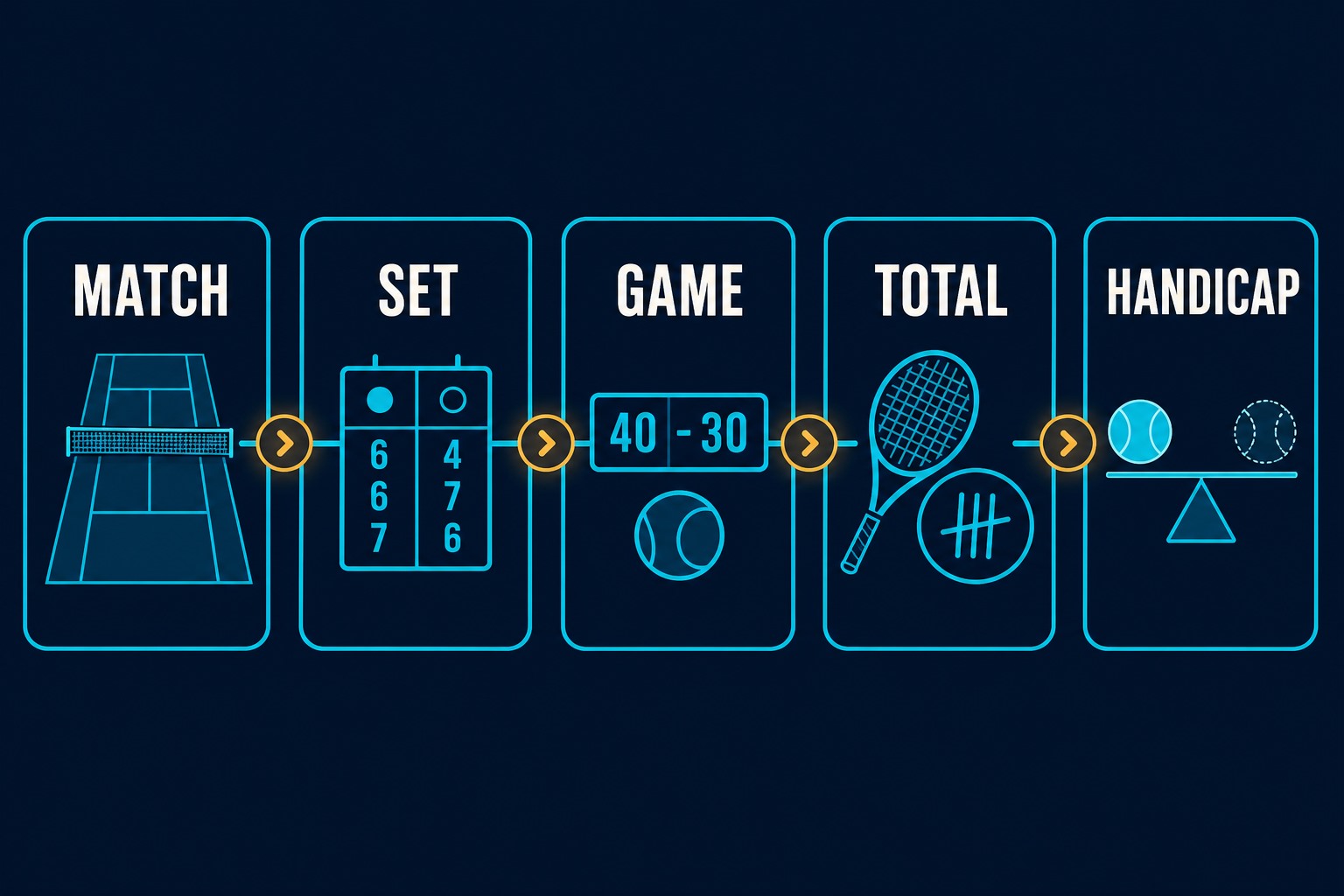
Copy the market exactly from the accepted slip. “Player A” is not enough. The bet might be match winner, first-set winner, total games, exact sets, game handicap, next game, or a player statistic. It may also specify best-of-three, best-of-five, a named set, or another time scope.
Then locate the rule hierarchy that applied to that bet: market text, tennis-specific rules, general house rules, and any event note shown on the slip. Save the page and date because operators can revise rules. Do not borrow a completed-set threshold from a search result about another operator or another product.
Betfair provides a useful third-party example of why this step matters. Its current Sportsbook tennis page describes one treatment for match bets in certain competitions, another for ITF, UTR, or exhibition match bets, and a separate test for other markets whose outcomes were already unequivocally determined. Its Exchange tennis page publishes yet another structure. These are Betfair rules for Betfair products, not a general tennis law and not evidence of a SuperAce88 rule.
Which Markets May Already Have a Result?
“Already decided” should be tested narrowly. A result must no longer be able to change within the market’s stated scope. A completed first-set winner is easier to assess than an over/under total that still depended on later games.
- Match winner: check the operator’s participation and retirement threshold. Advancing in the draw does not automatically answer settlement.
- Set winner: confirm that the named set reached its valid conclusion and that the rule permits completed segments to stand.
- Individual game: verify the exact game was completed and recorded. Do not infer it from the later match status.
- Total games or sets: ask whether the selected over or under was mathematically decided before play stopped and whether the rule recognizes that condition.
- Handicap: a partial score does not necessarily establish a final handicap result; read the settlement formula and retirement clause together.
- Player proposition: identify the statistic, named official source, and whether the market required the match or a particular segment to finish.
Three Hypothetical Reviews
Example 1 — no first point: Player B receives a walkover before the scheduled match. The official draw shows B advancing but no score. The review should not grade the slip simply as “B won.” It should ask how the accepted operator treats an unplayed match and whether the selection was a single or a leg of a multi-bet.
Example 2 — first set completed: Player A wins the first set 6–4, then retires at 1–2 in the second. A first-set winner market may have a completed sporting result, while the match winner, total games, and handicap markets require separate rules. The first-set result does not make every other selection settled.
Example 3 — selected total reached: a hypothetical “over 18.5 games” selection has already passed 18.5 when play stops. That looks mathematically decided, but the ticket still needs the rule that says an already determined market stands after a retirement. A calculation that seems obvious is not a substitute for the written clause.
These examples explain an audit method. They do not predict how any SuperAce88 ticket will be graded.
Interrupted Matches, Doubles Changes, Venue and Surface
Rain and darkness can stop tennis without ending the match. Preserve the score and server at suspension, the organizer’s notice, the resumed date, and the final result. Then check whether the sportsbook keeps the original bet active across a change of date or venue. Do not assume that “postponed” means void or that “resumed” guarantees every market stands.
For doubles, confirm the exact pairing. A replacement or changed team can matter even when the tournament listing looks similar. For a moved match, record any surface, indoor/outdoor, venue, format, or number-of-sets change. Some third-party rules say certain changes do not void bets; others distinguish format changes. The applicable ticket rule is the only safe basis for a conclusion.
Build a Tennis Settlement Evidence Pack
- Accepted ticket: bet ID, full market name, selection, line, odds, stake, accepted time, and whether it was a single or multi-bet.
- Official event record: draw, partial or final score, status code, governing body, and timestamps for suspension or resumption.
- Applicable rule: saved tennis, market, retirement, walkover, and multi-bet clauses with the access date.
- Settlement trail: original status, return calculation, balance entry, and any correction or resettlement.
- Support response: the specific rule and official result the operator says it used.
Please review bet ID [ID] for [match]. The accepted market was [exact market and selection], accepted at [time and timezone]. The official result shows [walkover/retirement/suspension and score]. Please identify the rule version, participation or completion condition, official result source, and calculation used for this single or multi-bet.
Redact passwords, one-time codes, identity numbers, full payment details, and unrelated bets before sharing evidence. A support review should not require remote access to your device or disclosure of an OTP.
For related explanations of market labels and settlement evidence, browse the Sports Betting guide library. Use the article that matches the exact sport and market rather than importing a rule from an unrelated event.
Responsible-Gambling Boundary
A disputed or pending tennis bet is an accounting question, not a reason to make another wager. Do not repeat a bet, raise a stake, or gamble on the next match to “recover” while the first ticket is unclear. Pause if the amount affects food, housing, bills, debt, medicine, or emergency savings. Only use gambling services where you are legally permitted, and treat every stake as money that can be lost.
Frequently Asked Questions
Is a walkover the same as a retirement?
No. A walkover normally records advancement without the scheduled match being played, while a retirement records a match that started and ended early. Confirm the official status and then apply the sportsbook’s current rule.
Does one completed set make a match bet valid?
Not universally. Some third-party rules use a completed-set threshold for particular products or competitions; others do not. Read the exact market and operator rule attached to the accepted ticket.
Can a completed first-set bet stand if a player later retires?
It may if the applicable rule recognizes completed or unconditionally determined markets, but that cannot be assumed. Confirm the official set result and the governing settlement clause.
Does a change of court, surface, or date void a tennis bet?
There is no universal answer. Save the event notice and check the ticket’s venue, scheduling, format, and surface rules. A rule from another sportsbook is only an example.
Reference Sources
- World Tennis/ITF: 2026 rules and regulations library
- USTA: walkover, retirement, withdrawal, and incomplete match status guidance
- Betfair Sportsbook: tennis rules (third-party operator example)
- Betfair Exchange: tennis rules (third-party product example)
Sources checked 3 August 2026. Rules can change; preserve the version that applied when your bet was accepted.
Editorial disclosure: Prepared by the SuperAce88 Editorial Team. This article explains evidence and rule-checking steps. It does not confirm SuperAce88 market rules, guarantee a result or refund, establish licensing status, or replace the accepted ticket, current terms, official event record, or applicable law.