
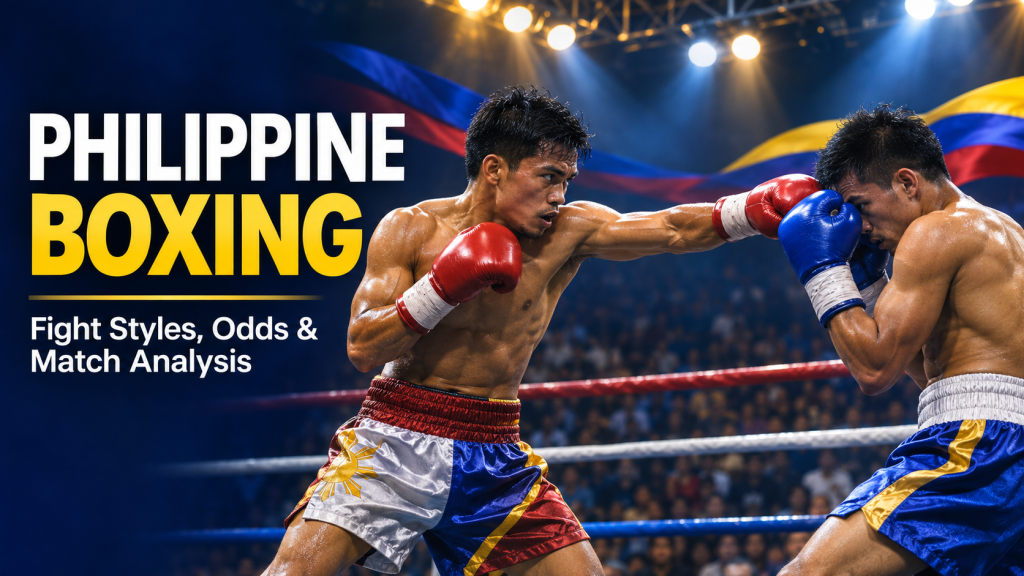
Boxing holds a special place in Philippine sport. A major bout featuring a Filipino fighter brings together national pride, technical skill and the anticipation of a contest that can change with a single clean punch. From local professional cards to international championship fights, the sport offers far more to explore than a boxer’s win-loss record.
This superace88 guide introduces Philippine boxing and explains how to read a matchup through its rules, weight division, styles and available betting prices. The aim is to connect what happens inside the ring with the questions that matter before the opening bell.
Why Boxing Matters in the Philippines
Philippine boxing has built an international identity through generations of accomplished fighters. Manny Pacquiao’s world titles across eight weight divisions provide a famous example of that reach. Gabriel “Flash” Elorde and Nonito Donaire are also central names in the country’s boxing heritage.
The national story extends beyond professional world titles. Nesthy Petecio and Aira Villegas both earned boxing bronze medals at the Paris 2024 Olympics, highlighting the strength of Filipino women in international competition.
| Name | Place in Philippine boxing | Useful context for fans |
|---|---|---|
| Manny Pacquiao | Eight-division world champion | A reference point for understanding movement between weight divisions |
| Gabriel “Flash” Elorde | A major figure in the country’s championship heritage | Connects modern fans with an earlier generation of Filipino boxing |
| Nonito Donaire | A prominent Filipino world champion | Part of the country’s sustained presence on the international stage |
| Nesthy Petecio | Paris 2024 Olympic bronze medalist | Highlights Filipino achievement in women’s international boxing |
| Aira Villegas | Paris 2024 Olympic bronze medalist | Another important example of the country’s Olympic boxing success |
These achievements explain the enthusiasm surrounding Filipino fighters. Evaluating a particular matchup still means examining the two athletes who will actually enter the ring, rather than treating nationality or a famous gym as a prediction.
Understand the Type of Boxing Competition
Professional Fights and Championship Bouts
Professional boxing includes developing prospects, domestic contests, regional title fights and world championship events. In the Philippines, the Games and Amusements Board regulates and supervises professional boxing through its relevant division.
Four-, six-, eight- and ten-round contests can appear on professional cards, while many men’s world championship bouts are scheduled for 12 rounds. Confirm the announced format for the specific event: round count and round length can differ by competition, category and sanctioning rules.
Olympic-Style and Tournament Boxing
Olympic-style boxing uses its own competition format and regulations. A fighter’s tournament success is useful background, but a professional contest may demand different pacing, longer-round experience and adjustments to a different opponent pool.
| Competition type | What to confirm | Why it affects analysis |
|---|---|---|
| Developmental professional bout | Scheduled rounds and opponent experience | A short contest offers less time to recover from a slow start |
| Domestic or regional title contest | Exact title rules and distance | The label alone does not establish the number of rounds |
| World championship bout | Sanctioning body, weight and agreed format | Preparation and late-round experience become important |
| Olympic-style tournament bout | Tournament rules and scoring format | Professional assumptions may not apply |
How Boxing Scoring and Results Work
Professional contests commonly use the 10-point must system. A typical round goes 10–9 to its winner; knockdowns, dominant rounds and deductions can change that score. Judges assess clean punching, effective aggression, ring control and defense under the applicable criteria.
Walking forward does not automatically win a round. A pressure fighter needs to land effective punches, while a moving boxer needs to turn positioning and defense into scoring opportunities.
Common outcomes include a knockout, a technical knockout, a judges’ decision and a draw. Technical decisions, disqualifications and no contests can also occur. Those distinctions matter because a bookmaker’s market rules determine how each outcome settles a particular selection.
Boxing Betting Markets Explained
For superace88 readers, the clearest starting point is to identify exactly what must happen for a market to win. Predicting the victorious boxer and predicting the way the fight ends are different tasks.
| Market | What the selection concerns | Detail to check before choosing |
|---|---|---|
| Fight winner / moneyline | The officially declared winner | Whether a draw is a separate outcome or causes a refund |
| Method of victory | A boxer winning by a listed method | Whether KO, TKO and disqualification are grouped together |
| Total rounds | The fight ending before or after a stated threshold | The exact time boundary and treatment of unusual endings |
| Goes the distance | Whether the scheduled distance is completed | How technical decisions and altered bout lengths are handled |
| Round or round-group betting | A finish in a particular round or range | Whether a specific winner and method are also required |
Market availability varies by event and provider. These are general boxing market categories, not a statement that every market is offered on a particular website.
Why Total-Rounds Rules Deserve Attention
An over/under line such as 8.5 rounds often uses the midpoint of round nine as its boundary. In a three-minute-round bout, that is 1:30 into the ninth round. Check the operator’s wording for the precise boundary, an ending exactly at that time and any exceptional settlement conditions.
A fight that reaches the scorecards after an accidental foul may not be treated the same way as one that completes the full scheduled distance. The market definition matters as much as the official result label.
How to Analyze a Boxing Match Before Betting
1. Compare the Weight Class and Weigh-In Context
A move in weight can change a matchup substantially. Consider how the fighter performed at the new weight, the size of recent opponents and any verified difficulty making the contracted limit.
A larger boxer may have physical advantages, but size alone does not establish control. Balance the measurements against footwork, accuracy and the ability to maintain an effective pace.
2. Look Beyond the Record
A 20–0 record and a 16–3 record do not reveal the quality of opposition. Examine whom each boxer faced, how competitive those fights were and whether the recent performances resemble the challenge ahead.
Watch full rounds where possible. Highlight clips show successful moments while leaving out defensive mistakes, recovery periods and the work required to create an opening.
3. Study the Style Matchup
| Matchup | Questions to investigate | How it can shape the contest |
|---|---|---|
| Pressure fighter vs outside boxer | Can the pressure fighter cut off the ring? | Determines whether exchanges happen at close range or behind the jab |
| Counterpuncher vs high-volume attacker | Who lands cleanly during entries and exits? | Volume can create openings for either boxer |
| Southpaw vs orthodox | Who controls lead-foot position and the straight-punch lane? | Positioning may influence the most effective attacking angles |
| Body puncher vs mobile opponent | Can body work be established without losing early rounds? | Sustained body attacks may influence later movement and pace |
| Powerful finisher vs durable opponent | Has the power worked against comparable opposition? | Helps assess whether a stoppage scenario has convincing support |
These are analytical possibilities rather than automatic outcomes. A southpaw is not guaranteed an advantage, and a pressure fighter does not necessarily force a stoppage.
4. Assess Distance, Activity and Recent Form
Compare experience over the scheduled distance, recent activity and the quality of the last few performances. A boxer who has only completed short bouts may face new pacing demands in a longer contest.
Separate verified information from speculation. Publicly confirmed changes in opponent, preparation time or contracted weight deserve attention; an unverified training rumor should not carry the same weight.
How to Read Boxing Odds
Decimal odds show the total return for a winning selection, including the original stake. Their reciprocal gives a break-even probability before considering how bookmaker margin affects the market.
Implied probability = 1 ÷ decimal odds × 100
| Illustrative decimal odds | Implied probability | Total return on a winning ₱100 stake | Net profit |
|---|---|---|---|
| 1.50 | 66.67% | ₱150 | ₱50 |
| 1.80 | 55.56% | ₱180 | ₱80 |
| 2.00 | 50.00% | ₱200 | ₱100 |
| 2.50 | 40.00% | ₱250 | ₱150 |
| 3.00 | 33.33% | ₱300 | ₱200 |
These are calculation examples, not live prices or recommended wagers. The implied probabilities across a bookmaker’s full market will typically total more than 100% because of its pricing margin.
For superace88 readers comparing a favorite and an underdog, the useful question is whether the available price matches the evidence. The boxer most likely to win is not automatically attractive at every price, and a bigger potential return does not make a weaker selection better supported.
Worked Example: Turning Match Analysis Into a Price Comparison
Imagine a fictional ten-round contest between Boxer A, a mobile jab-based fighter, and Boxer B, a pressure fighter with a strong body attack.
Boxer A is offered at 1.80. That price requires a win probability above approximately 55.56% to have positive expected value under the assumed settlement terms. If an analyst estimates A’s actual chance at 60%, the price appears favorable within that analyst’s model. If the estimate is only 52%, the same price does not support the selection.
The difficult part is establishing a reliable estimate. The calculation is useful because it exposes the assumption; it does not verify that assumption.
| Observation in the fictional matchup | Question it raises | Evidence to look for |
|---|---|---|
| Boxer A has a longer reach | Can A keep B outside? | Full-fight footage against effective pressure |
| Boxer B attacks the body | Can B slow A’s movement? | Accuracy, entries and sustained body work |
| The fight is scheduled for ten rounds | Who can maintain the pace? | Previous late-round performances |
| A is priced at 1.80 | Does the evidence justify more than 55.56%? | A balanced assessment of both winning paths |
This approach also helps decide when there is too little information to form a useful view. A clear analysis can end with no selection.
Common Mistakes When Analyzing Filipino Boxing Matches
Confusing Fan Support With a Matchup Advantage
Supporting a Filipino boxer can make an event more engaging. Keep the sporting case specific: opponent quality, style, weight and recent performance provide more useful evidence than popularity.
Using Knockout Percentage on Its Own
A high knockout rate needs context. Consider the opponents’ level, the weight at which those stoppages occurred and whether the upcoming rival has faced similar power.
Treating Related Selections as Independent
Backing one boxer to win, the same boxer by stoppage and the fight to end early can all depend on the same scenario. Track the combined amount committed to the bout rather than viewing each selection in isolation.
Philippine Boxing Betting FAQ
What Should Beginners Study First?
Start with the scheduled distance, weight class, recent opposition and styles. Then read the available market definitions and odds. Understanding the contest comes before comparing prices.
Does a Longer Reach Guarantee an Advantage?
No. Reach is useful when a boxer can maintain range and land effectively. Footwork, timing and the opponent’s ability to enter safely determine how much that measurement matters.
Is a Favorite More Likely to Win by Knockout?
Being favored to win does not identify the method. A favorite may have a stronger case through accuracy and round-winning ability than through finishing power. Assess the method separately.
Are Professional and Olympic Boxing Analyzed the Same Way?
They share technical skills, but format, pacing and competition rules can differ. Confirm which type of event you are watching before using assumptions about round length, scoring or distance.
What Should Be Checked Immediately Before a Bout?
Confirm the participants, official weigh-in information, scheduled rounds, start-time updates and current market terms. For events held abroad, distinguish the beginning of the broadcast from the expected main-event ring walks and use the announced Philippine viewing time where available.
Build a Clearer Fight-Night View
Philippine boxing combines a celebrated sporting tradition with varied technical matchups. Understanding how a contest is scored, how the two styles interact and what a price implies makes the event easier to evaluate from the first round to the final announcement.
Use this superace88 guide as a framework for future fight previews: identify each boxer’s winning path, test it against recent evidence and compare that assessment with the precise market offered. If you choose to wager, follow applicable local rules, meet the operator’s age and eligibility requirements and keep a fixed entertainment budget.