
Quick answer: before you deposit or request a withdrawal, compare the casino account holder, the payment-account owner, the intended recipient and the payment route. If the names or route do not align, stop and check the current written rule and secure upload path before sending money or documents. Payment ownership proof can connect a method to an account holder; it does not prove that a payout will be approved.
This is a platform-neutral evidence checklist. It does not state which payment methods SuperAce88 supports, which documents it requests, how long a review takes, what fees or limits apply, or whether a withdrawal will be approved. Those details must come from the exact platform’s current terms and verified account route.
Use the page to make one decision: is the payment method and its evidence route coherent enough to continue, or should you pause and verify independently?
What payment-method ownership verification actually checks
An ownership check asks whether the bank account, card, e-wallet or wallet belongs to the person who controls the gaming account, or whether a current rule explains another permitted arrangement. The recipient, currency, network, account identifier and written terms also need to make sense.
Keep four questions separate:
- Payment ownership: does the payment account belong to the gaming-account holder?
- Identity/KYC: has the platform completed its identity, age or address check?
- Source of funds: has a provider asked where money came from? This is a separate review.
- Payout approval: has the operator made a final decision and has the provider posted funds? Ownership proof alone answers none of these.
Operator help pages can illustrate one workflow, but they are not a universal document list. The authenticated request and privacy notice for the platform in front of you are the source of truth.
Run the four-party match before money moves
Make the comparison while the transaction details are still visible. Save the final hostname, date and currency; do not rely on a screenshot of a message that might change later.
| What to compare | Evidence to record | Pause if you see |
|---|---|---|
| Account holder | The name and verified contact shown in the account, plus the date checked | Inaccurate details, a borrowed identity, or a request to use another person’s profile |
| Payment owner | Owner name and identifying fields shown by the bank, card issuer, e-wallet or wallet portal | The method is controlled by somebody else and no current written rule explains a permitted arrangement |
| Recipient and route | Displayed recipient, currency, network or bank route, reference number and final domain | A recipient, QR code, wallet address or payment route changes in a chat or private message |
| Written rule | Payment, withdrawal, verification and privacy URLs with the date or version checked | A material condition appears only after money is sent, or the rule conflicts with the account screen |
| Secure evidence path | The exact portal or in-account upload screen, request wording and receipt number | Support asks for documents by an unverified email, social DM, shortened link or unknown upload form |
Philippine regulators warn that illegal online sites can expose players to scams, identity theft and credit-card fraud. A familiar logo or a search result is not proof of the final domain. Open the site yourself, inspect the current terms and confirm that the payment route belongs to the company you intend to reach.
Collect useful proof without exposing the account
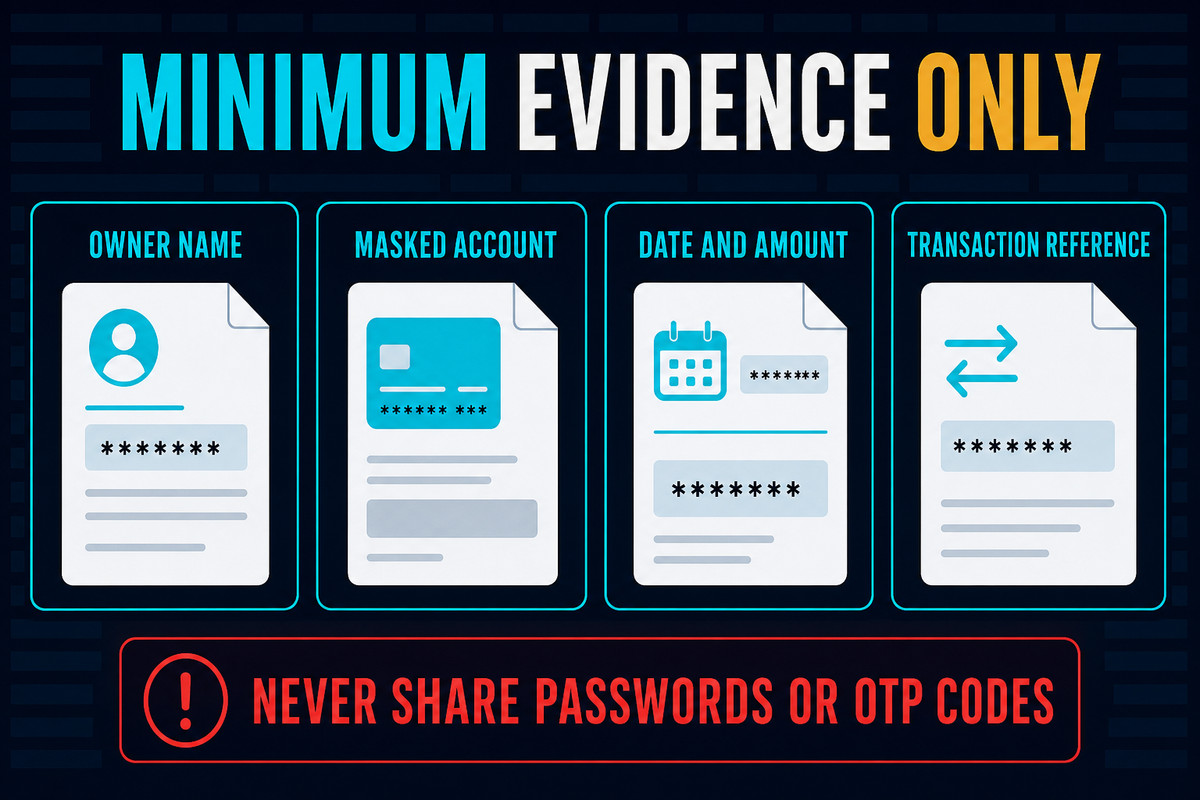
Only provide what the verified request requires, through the route you independently checked. A screenshot should answer the ownership question and preserve the request context; it should not become a copy of every financial detail in your account.
| Payment route | Record for the private evidence log | Redaction and hard-stop rule |
|---|---|---|
| Card | Issuer or portal name, account-holder name, permitted visible digits, request ID, amount, currency and timestamp | Mask fields only when the verified request permits it; never share CVV, PIN, password or one-time code |
| Bank or e-wallet | Owner name, the permitted account identifier, recipient, transaction reference and posted/pending status | Mask unrelated balances and transactions when allowed; never hand over login credentials or an OTP |
| Cryptocurrency wallet | Asset, amount, network, transaction hash, sending address, receiving address and confirmation state | Never disclose a seed phrase, private key or recovery phrase; verify the network and address before sending |
| Payment app or QR route | Recipient name shown in the official app, reference, amount, currency and time | Do not trust a new recipient or QR code supplied in a message; leave and reopen the known app or website |
The Philippines National Privacy Commission says a privacy notice should explain the data, purpose/basis, method, recipients, controller contact, retention and data-subject rights. Read the notice and ask through its named route whether non-essential fields may be masked. Never alter a document deceptively or send a full statement when it is not required.
Verify the upload or support route first
- Leave the message. If a person sends an unexpected link, number, QR code or attachment, do not use it to reach the cashier or support team.
- Navigate independently. Type the confirmed domain or use a bookmark you created earlier. Check the address bar, HTTPS connection and account context.
- Read the request in context. Note the exact evidence category, purpose, recipient/controller, retention statement and case number. Do not infer requirements from a different operator’s help page.
- Upload once through the authenticated route. Save the request wording, timestamp, file name, upload receipt and resulting status. Keep the unredacted original privately.
- Protect authentication factors. A support person does not need your password, PIN, OTP, recovery code, seed phrase or remote access to “verify” a payment method. For a wider phishing and account-safety checklist, see the account security and phishing guide.
The US Federal Trade Commission advises using a phone number or website known to be real, double-checking the recipient and refusing requests for credentials or fees to claim winnings. These are general safety principles, not Philippine law.
What to do when the names or route do not match
Do not solve a mismatch by borrowing another person’s method, repeatedly resubmitting, changing a wallet address in chat or sending another deposit. Pause and ask for the exact rule, missing evidence and recognised secure route.
Record the exact status; pending, processed and rejected are platform-specific. See the pending or rejected withdrawal evidence checklist for status evidence and the support and transaction-record guide for case records.
Use a focused message through the verified in-account channel:
Please confirm the recorded payment-ownership requirement for request [ID]. The account holder, payment method, recipient, amount, currency and submission time are [details]. Please identify the exact evidence category still required, the secure upload route, the applicable term or privacy notice, and the case number. Please do not request passwords, one-time codes, recovery phrases or unrelated financial information.
If money or credentials were exposed, contact the bank, issuer or provider through its official channel and preserve the record. The FTC notes that cryptocurrency transfers are typically not reversible. No checklist guarantees reversal, payout or complaint outcome.
How this page differs from the SuperAce88 deposit guide
The broader deposit and withdrawal verification checklist covers a complete before/during/after evidence workflow. This page isolates one decision: whether the payment method and its proof can be tied to the account holder through a secure, minimum-disclosure process. It does not add a SuperAce88 provider list, cashier instructions, KYC document list, fee, limit, processing time, licence statement or payout promise.
Frequently asked questions
What payment proof is universal?
None. Card, bank, e-wallet and crypto reviews can use different fields. Follow the authenticated request and privacy notice; an operator’s sample is not a universal rule.
Can I use another person’s card or bank account?
Do not assume it is allowed. A name mismatch can trigger an ownership review. Stop, read the current terms and ask the verified route what arrangement, if any, is permitted. Never disguise the owner or alter evidence.
Does payment ownership proof mean my withdrawal is approved?
No. Identity, source-of-funds, bonus, status and provider checks may be separate, and the provider must still post the funds. Keep the exact status and reference.
Should I send an OTP, password or recovery phrase to support?
No. These credentials authenticate you; they are not proof that a payment method belongs to you. Stop the conversation and reopen the official site or app independently if anyone requests them.
Does this page confirm SuperAce88 payment methods or withdrawal rules?
No. It is a neutral evidence guide. Check the exact account screen, current terms, privacy notice and verified support route; this is not a method, fee, limit, speed or payout statement.
Primary reference sources
- PAGCOR: Warning against illegal online gambling sites
- Philippines National Privacy Commission: The right to be informed
- US FTC: How to avoid scams with mobile payment apps
- US FTC: Recognize and avoid phishing scams
- US FTC: What to do if you were scammed
- UK Gambling Commission: Age, ID and financial verification
Jurisdiction note: PAGCOR and the National Privacy Commission sources describe Philippine context. The FTC sources are US consumer guidance. UK Gambling Commission pages describe UK rules and expectations. None of these sources establishes SuperAce88’s licence, payment methods, document requirements, fees, limits, processing time or payout outcome.