
Quick answer: a quarter Asian Handicap line is normally read as two adjacent half-lines. For example, +0.25 splits the stake between 0 and +0.5; -0.75 splits it between -0.5 and -1.0. Settle each half against the final margin, then combine the two labels. That is why one ticket can show a half-win, half-loss or push. The operator’s published line, price, time scope and settlement rule still control the final account entry.
Four-step check: copy the exact handicap; split a quarter line into its two neighbouring half-lines; calculate the adjusted margin for each half; compare the result with the current rule and ticket ledger. This guide explains settlement math, not value, picks, staking systems or a SuperAce88-specific promise.
Read the line before reading the result
Asian Handicap is a margin market. One side receives a virtual goal, run or point adjustment, so the final score is compared with an adjusted margin rather than a simple win-or-lose result. Whole-number and half-number lines usually produce a full win, full loss or push. A quarter line divides the stake between two neighbouring lines, which allows a half outcome.
| Quoted line | Split or adjustment | Possible labels | Reader check |
|---|---|---|---|
| 0 (level ball) | No virtual margin. | Win, loss or push. | Confirm whether a tie returns the stake under the market rule. |
| +0.5 / -0.5 | Half a goal, run or point. | Normally win or loss; no exact tie on the adjusted line. | Check the sport’s scoring and official result. |
| +0.25 | Half stake at 0 and half at +0.5. | Full win, half-win or loss under the common split model. | Record the two component lines; a push can occur only on the 0 component. |
| -0.25 | Half stake at 0 and half at -0.5. | Full win, half-loss or loss under the common split model. | Do not treat a draw as a full loss; the 0 component pushes. |
| +0.75 | Half stake at +0.5 and half at +1.0. | Full win, half-win or loss under the common split model. | A push can occur on the +1.0 component, producing a half outcome. |
| -0.75 | Half stake at -0.5 and half at -1.0. | Full win, half-loss or loss under the common split model. | A push can occur on the -1.0 component, producing a half outcome. |
The split is an explanatory model used by many sportsbook rules. It does not override an operator’s notation, rounding, dead-heat, abandoned-event or in-play clause. Betfair and bet365 publish separate Asian Handicap explanations, which shows why the exact market rule must be read before comparing a ticket with a generic calculator.
How to calculate a quarter line
Write the quoted line and two component lines on paper. If the selection is the underdog at +0.25, the stake is divided between 0 and +0.5. If the selection is the favourite at -0.75, the stake is divided between -0.5 and -1.0. Do not round the final score before evaluating both components.
For a two-way sport, use the selection’s final margin from the opponent. A positive margin means the selection finished ahead; zero is a tie; a negative margin means it finished behind. Then apply the virtual adjustment to each component:
- Write selection margin + handicap for the component line.
- Classify that component as win, push or loss according to the current rule.
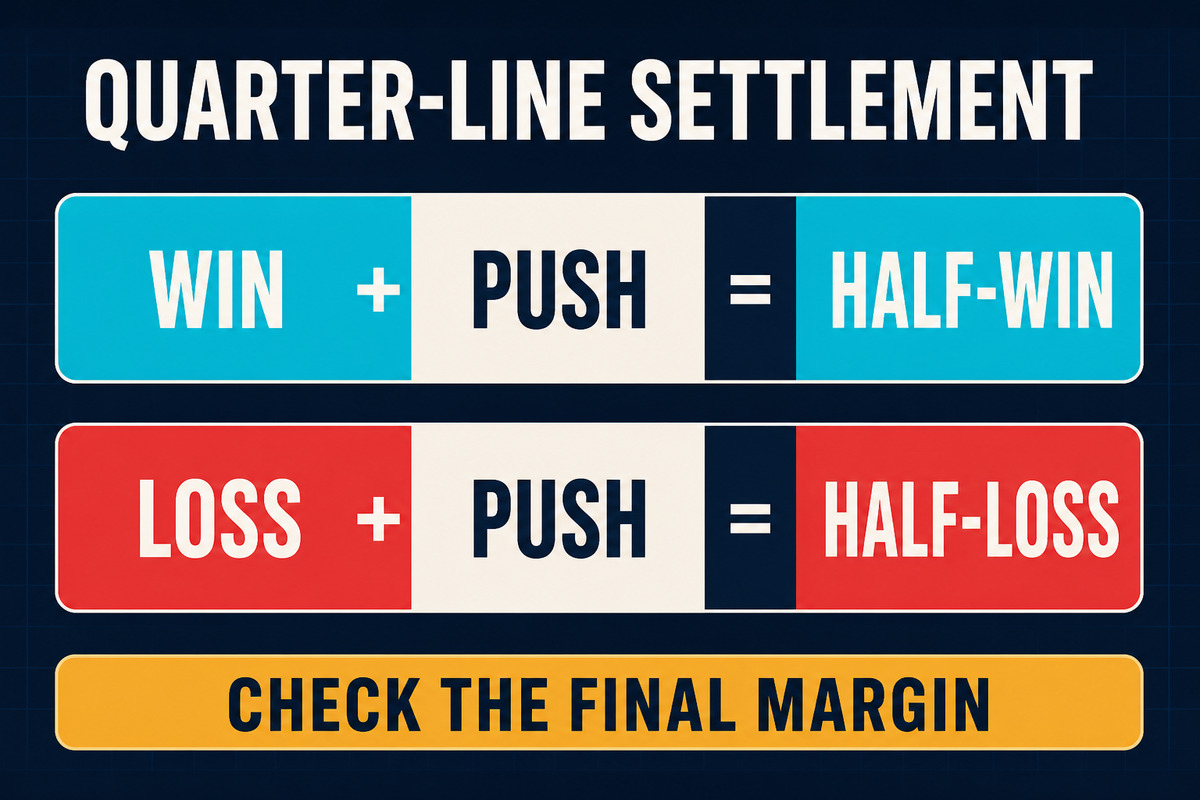
- Combine the labels. Win plus push is a half-win; loss plus push is a half-loss; push plus push is a full push.
These labels describe the outcome relationship only. They do not say whether an account credit has posted, what odds were used, or whether a payment provider has completed a transfer.
Worked hypothetical examples
The examples use one stake unit for each half and omit odds, fees and currency. They are hypothetical: verify the event result, stake split and account ledger against the platform’s rule.
| Line and selection | Final margin | Component calculation | Combined label | What to verify |
|---|---|---|---|---|
| Underdog +0.25 (0 / +0.5) | Draw, 0 | 0 half: push; +0.5 half: win | Half-win | Ticket shows a quarter-line split and the tie is settled as push. |
| Underdog +0.25 (0 / +0.5) | Loses by 1 | 0 half: loss; +0.5 half: loss | Loss | Official score and the market’s abandoned-event rule. |
| Favourite -0.75 (-0.5 / -1.0) | Wins by 1 | -0.5 half: win; -1.0 half: push | Half-win | Minus sign, exact margin and whether a tie on -1.0 is a push. |
| Favourite -0.75 (-0.5 / -1.0) | Draw, 0 | -0.5 half: loss; -1.0 half: loss | Loss | No goals or points were removed by a correction or special rule. |
| Selection -0.25 (0 / -0.5) | Draw, 0 | 0 half: push; -0.5 half: loss | Half-loss | Selection direction and whether the display uses an equivalent notation. |
| Underdog +0.75 (+0.5 / +1.0) | Loses by 1 | +0.5 half: loss; +1.0 half: push | Half-loss | One-unit margin and the rule for a push on +1.0. |
If the platform displays a combined label instead of two components, ask support to explain the component settlement. If the final score later changes, save both the original and corrected result. A generic table cannot resolve a sport-specific correction, postponed event, dead heat or tournament rule.
In-play and event-status checks
In-play markets may use the score or game state at the moment the bet is accepted as a baseline. Some rules state that the match’s starting score is not the same as the score when the bet is placed. Never copy a pre-match example into an in-play ticket without checking the in-play section. A suspended, abandoned or postponed event can also trigger a separate clause.
For timing and suspension questions, use the live betting delay and suspended-market guide. If the market is a player prop, the player-props settlement guide has a different evidence path. The broad sports terminology article explains vocabulary; this page focuses on arithmetic and settlement records.
Save a settlement worksheet
Before asking support, keep a private worksheet containing the exact line, two component lines, stake allocation, odds as displayed, final official result, any in-play baseline and the ticket’s status history. Add the rule URL and time checked. A worksheet is for your own evidence; do not publish personal identifiers or payment details.
- Copy the ticket ID and line exactly, including the plus or minus sign.
- Write the two adjacent lines and mark half of the stake against each.
- Record the official score or margin and any correction notice.
- Apply the current rule to each half and note the combined label.
- Compare the label with the ledger entry, then ask one focused question if they differ.
What this guide does not establish
- It does not establish that Asian Handicap offers better value, lower risk or a reliable profit.
- It does not provide picks, staking advice, odds predictions or a way to defeat a bookmaker.
- It does not establish SuperAce88’s current odds, lines, market availability, fees, limits, licence status or payout policy.
- It does not replace the operator’s exact in-play, postponed-event, correction or dead-heat clauses.
- It does not promise a refund or account credit; the ledger and payment provider control that evidence.
Frequently asked questions
Why can a quarter line produce a half-win?
The stake is split between two neighbouring half-lines. If one component wins and the other pushes, the combined ticket is a half-win. The same logic creates a half-loss when one component loses and the other pushes.
Is +0.25 the same as +0.5?
No. +0.25 is commonly split between 0 and +0.5, while +0.5 is one half-line. The component lines, score margin and settlement differ.
What happens when the favourite wins by exactly one?
On a -0.75 example, the -0.5 component can win and the -1.0 component can push, producing a half-win under the common split model. Confirm the operator’s notation and tie treatment.
Can I use a calculator instead of the ticket rule?
A calculator can illustrate the split, but it cannot decide an operator’s event-status, in-play baseline, correction or dead-heat clause. Use it as a worksheet, then compare with the published rule and ledger.
Does this article confirm a SuperAce88 Asian Handicap result?
No. It is a neutral math and evidence guide. Use the current authenticated ticket, exact terms and verified support channel for a product-specific decision.
Sources and editorial disclosure
- Betfair: Asian Handicap rules – operator-specific split-line examples.
- bet365: football Asian Handicap rules – a separate operator example of half-stake settlement and in-play scope.
- UK Gambling Commission: settling bets in accordance with published rules – why settlement clauses should be published.
- UK Gambling Commission: display of betting rules – access to rules before acceptance in the UK framework.
- PAGCOR: electronic gaming regulatory information – Philippine regulatory context, not a ticket calculation.
- Asian Handicap Guide: summary table – secondary SERP explanation used only to cross-check terminology.
Jurisdiction and evidence note: sources were checked on 9 August 2026. Betfair and bet365 pages describe their own rules; UK Gambling Commission pages describe UK requirements; PAGCOR provides Philippine regulatory context; the Asian Handicap Guide is a secondary explainer. None establishes SuperAce88’s licence, line, price, in-play baseline, payout or support outcome. Examples are hypothetical and require independent article QA.